
Separate the person from the campaign
Charli D'Amelio and Whitney Simmons are two influencer examples with documented brand collaborations. D'Amelio is associated with dance and social entertainment; Simmons with fitness content. Their names help identify the creator. The campaign tells you what the brand and creator actually did together.
That distinction changes how you research a partnership. A popularity list can help you recognize people. It cannot tell you which deliverables a shop should buy, what permissions are included, or whether a campaign produced profitable orders.
This article examines two official brand accounts of collaborations, then turns the mechanics into a small-shop Instagram plan. The sources establish specific campaign details. They do not provide enough information to calculate return on spend, and the proposed small-shop plan is hypothetical.
What Dunkin and Gymshark actually built with creators
Charli D'Amelio × Dunkin: make the creator's preference orderable
Dunkin's September 2, 2020 announcement turned D'Amelio's usual cold brew combination into a named menu item, “The Charli.” It described in-store and app ordering, an Instagram photo contest, social content, and a TikTok song. Dunkin's original announcement.
The useful mechanism is a short path from creator association to a specific product choice. A viewer could ask for the named item. The product, creator, and next action connected directly.
For a small coffee shop, a possible adaptation is a creator's genuinely selected drink available for a defined period. For an online store, it might be a creator's selection of existing items, with a landing page showing exactly what is included. These are proposed adaptations, not claims about Dunkin's operating plan.
Prerequisites: The creator has a real reason to choose the product; the shop can fulfill the promised item; staff or the destination page can explain the offer. Agree on how the creator's name and content may be used.
Unknowns: The cited announcement does not establish the creator fee, campaign budget, incremental sales, or acquisition cost. The contest and promotion were historical; their dates are not current instructions.
Whitney Simmons × Gymshark: give the collaboration a concrete product identity
Gymshark's archived collection article describes a fifth collaboration with Whitney Simmons, presented there as the final collection. It connects the collection to her outlook and introduces the capsule's designs. Gymshark's collection article.
The mechanism is a product proposition shaped around a creator's recognizable identity. A named collection provides something specific to inspect, discuss, and shop.
A small store usually cannot reproduce the product-development investment behind a large apparel collaboration. It can test a narrower idea: ask a creator to select a set of existing items for a defined use, explain the choices, and point viewers to the exact bundle. Call that a curated selection unless the creator actually helped design the products.
Prerequisites: The selection reflects a real use case; stock is available; the creator can explain why each item belongs; responsibilities for promotion and customer questions are clear.
Unknowns: The cited page does not establish collaboration fees, attributable sales, or the creator's complete Instagram posting schedule. Its “final collection” wording belongs to that archived article and should not be treated as a claim about every later relationship.
| Campaign | Documented mechanism | Adaptation to consider | Information still needed before budgeting |
|---|---|---|---|
| D'Amelio × Dunkin | Named product preference with an ordering path | Creator-selected item with an exact offer | Creator quote, fulfillment cost, margin, deliverables |
| Simmons × Gymshark | Named collection tied to creator identity | A clearly labeled curated set of existing items | Selection work, usage scope, stock, content and distribution fees |
Choose the part a small shop can repeat
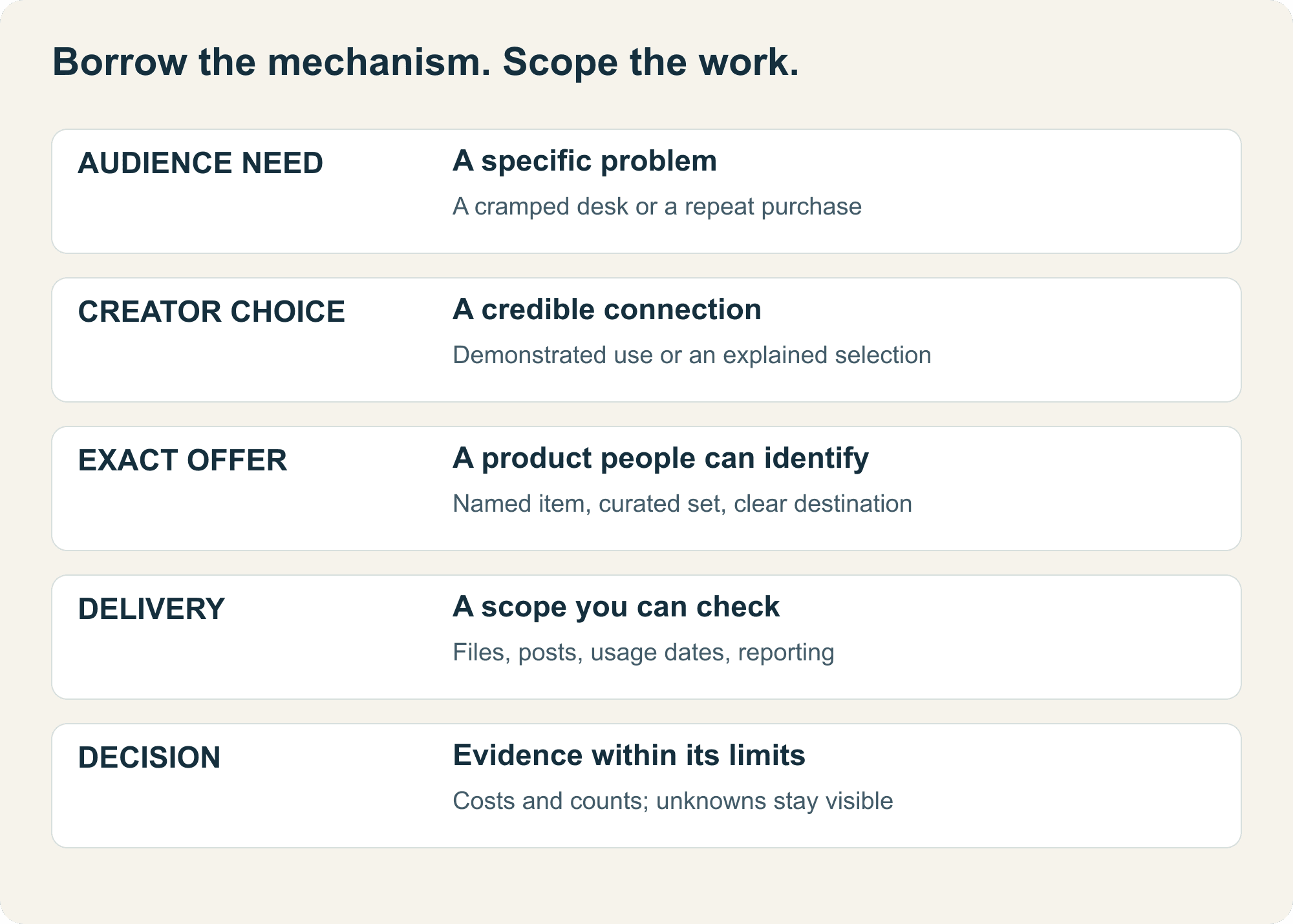
Start with your customer's problem. For a desk-accessory shop, “My small workspace gets cluttered” is a more useful brief than “Find someone with a large following.” Review whether the creator actually demonstrates desk setups and whether their content explains product choices clearly.
Ask for recent examples relevant to the placement you want. Check whether viewers ask practical questions and whether the creator answers them. Public engagement is a screening clue. It is not proof of audience location, buying intent, or sales.
Discuss three things separately:
- Creative work: What will be made, and who approves factual claims?
- Distribution: Where will it appear, for how long, and what reporting will the creator supply?
- Usage: Can the brand repost, edit, or advertise the material, and during which dates?
A paid file delivered to your drive can be useful even if the creator never posts it. A creator's published endorsement adds their distribution and public association. Price and evaluate the deliverable you are actually commissioning.
A practical Instagram influencer marketing campaign
Here is a hypothetical plan for a shop selling a folding phone stand. All costs and timing below are assumptions for planning, not observed creator rates or results.
Goal: Help small-desk users judge whether the stand suits their setup, then send them to a page with dimensions and compatibility details.
Creator fit: A creator who regularly shows compact workspaces, owns a compatible phone, and can demonstrate the supplied sample. Ask them to disclose the paid relationship clearly in the endorsement. For U.S. audiences, the FTC's endorsement guidance is the primary reference for material-connection disclosures.
Agreed delivery: One Reel showing the stand in an actual desk setup, plus three Story frames: problem, demonstration, and destination link where the account supports it. Request caption text and a report of available placement metrics. Do not assume every account exposes the same fields.
Creative direction: Open with the crowded desk. Show the stand unfolding, place the actual phone, and show the resulting view. End with “Check the dimensions for your phone and case.” Let the creator describe genuine observations in their own words. Do not require a positive review or invent a week of use.
Timeline:
| Stage | Owner | Required output |
|---|---|---|
| Days 1–2 | Shop | Sample, fact sheet, agreement, working destination |
| After receipt, days 3–5 | Creator | Rough demonstration and proposed caption |
| Day 6 | Shop | One consolidated factual and disclosure review |
| Day 7 | Creator | Approved files and agreed publication schedule |
| Publication through day 14 | Both | Saved placement metrics, questions, link sessions, order records |
Shipping delays move the shoot schedule. Set dates against actual receipt instead of asking the creator to demonstrate a product that has not arrived.
Budget assumption: $250 creative work + $150 creator distribution + $30 sample and delivery + $70 editing = $500. Paid amplification is excluded. Agree on any reposting license separately; this example includes no assumed perpetual or paid-ad rights.
Tracking: Use one destination URL with a campaign tag and a different content tag for each clickable placement. Offer an agreed code if useful, but do not rely on it as the only measurement. Save the published assets and metric reports with their capture dates.
Download the completed Instagram campaign brief to adapt the plan. For a campaign centered on obtaining ad creative, use the UGC marketing workflow.
Track delivery, audience response, and business results separately
First confirm the purchased work arrived: correct placements, accurate claims, visible disclosure, live links, and agreed reporting. A missing Story link is a delivery issue, even if the Reel attracted attention.
Then report what happened without mixing denominators. Reel views, Story reach, link taps, website sessions, and purchases are different counts. A useful click measure for a Story is link taps divided by that Story's reach, when both are available. Do not divide it by total followers and call it a view-to-click conversion rate.
Consider an invented result: the campaign costs $500 and records 20 code-associated orders. Cost per code-associated order is $500 ÷ 20 = $25. If contribution before campaign cost is $12 per order, those orders contribute $240, leaving $240 − $500 = −$260 before other campaign costs.
That calculation describes the recorded orders under the stated assumptions. Codes can be shared, existing customers can use them, and some influenced customers buy without them. Twenty code-associated orders do not establish twenty additional orders caused by the campaign.
Use the first round to answer a bounded question: did the creator deliver useful content, did buyers understand the product, and do the observed economics justify another controlled attempt? Broader causal claims need a stronger comparison design and sufficient data.
What these sources establish
Dunkin's source is dated September 2, 2020. Gymshark's collection page is an archive with publication and revision dates; its navigation may contain newer collections. Both were checked on September 23, 2026. This article uses their campaign descriptions and avoids unsupported sales-lift figures.
Keep the same discipline in your own case study: name the creator, state the offer, list the deliverables, show the measurement window, and mark unknowns. That gives the next person a campaign they can evaluate and adapt.