
What a product advertisement needs to do
A phone stand appears on a clean background. The caption says “Built for your day.” It looks finished, but a buyer still has the same question: will it hold my phone where I need it?
A product advertisement promotes a specific product by connecting a useful benefit to a reason to believe it. A practical definition of product advertising is paid promotion intended to build awareness, consideration, or demand for a product. The advertisement is the individual piece: a video, image, sponsored post, or other paid message.
Brand-owned demonstrations can supply the creative for those placements. Their presence on a website alone does not establish that every asset ran as a paid ad.
For a small shop, the useful sequence is buyer question → supported claim → visible proof → next action. The two brand examples below show different proof mechanisms. The small-shop adaptation that follows is an original hypothetical exercise, with complete scripts you can use as a model.
Two product advertisements with a clear proof mechanism
Apple: let the output carry the claim
Apple's April 2022 Shot on iPhone Macro Challenge announcement identified ten winning photographs taken with iPhone 13 Pro or Pro Max. Apple said selected images would appear on its website, Instagram account, and billboards in selected cities. Apple's original announcement.
The creative lesson is the connection between a product capability and an inspectable output. The viewer can examine a photograph while seeing which device produced it. That makes the capability concrete.
What a small shop can borrow: Show the result your product helps create. A stamp seller could show a close view of the impression beside the stamp, paper, and ink used. A stencil seller could show the finished pattern with the actual application conditions.
What the example cannot establish: These are selected contest winners. They do not establish typical buyer results or a quantified sales effect. Lighting, operator skill, and selection matter. Keep those conditions visible when presenting your own best result.
Blendtec: build the creative around a testable question
Blendtec's official Will It Blend? page presents its demonstration series and links the videos to its blenders. The recurring premise puts a concrete question in front of the viewer. Blendtec's campaign page.
The transferable idea is an observable test with an outcome. For a normal household product, this could be opening a drawer with an organizer installed, adjusting a lamp to illuminate a page, or packing a bag with the named items.
What a small shop can borrow: State a question, show the starting conditions, perform the action, and hold on the result. Keep enough continuity for the viewer to understand what happened.
What the example cannot establish: A demonstration format does not prove durability, safety, or purchase intent. This analysis uses the official campaign page; it does not claim a frame-by-frame inspection of every embedded video. Use ordinary, product-approved conditions for your own test and avoid copying destructive stunts.
| Example | Proof mechanism | Useful small-shop adaptation | Missing commercial evidence |
|---|---|---|---|
| Apple macro challenge | Attributed product output | Show an output and disclose how it was made | Campaign spend and incremental sales are not established by the cited announcement |
| Blendtec demonstration series | Question followed by visible test | Show a normal use from setup to outcome | The cited page does not establish an acquisition cost or conversion lift |
Choose a proof format your product can actually support
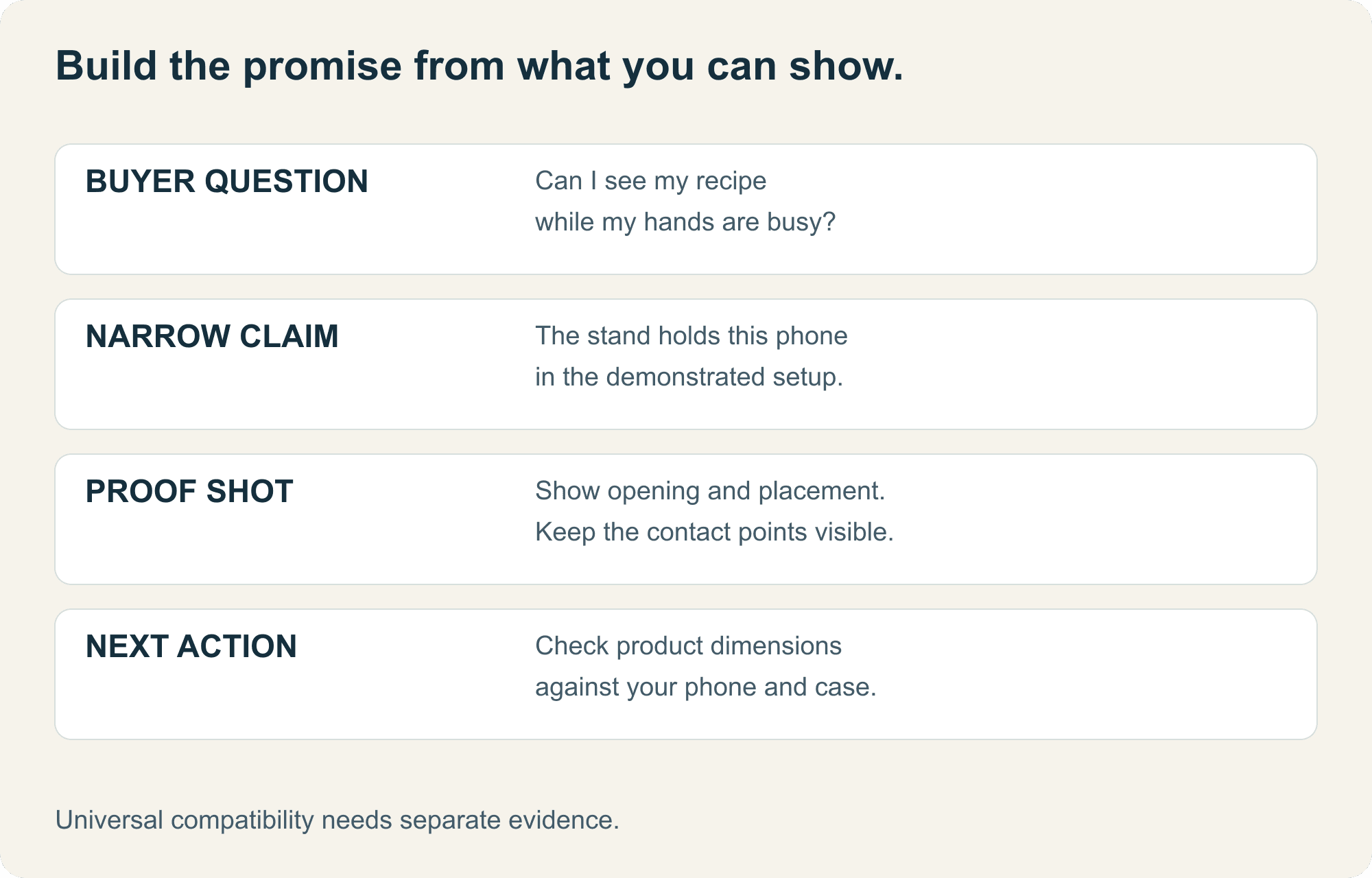
Start by writing the claim in plain language. “Opens into a phone stand” needs a visible opening sequence. “Fits all phones” needs a much broader compatibility basis. One shot of one phone will not support the broader promise.
Use this table before writing a hook:
| Buyer question | Candidate claim | Evidence to collect | Boundary to preserve |
|---|---|---|---|
| How does it work? | The support unfolds into position | Continuous setup footage | Show the actual mechanism |
| Will it fit my space? | These are its folded dimensions | Measurement against a ruler and product specification | Name the measured model |
| What will the output look like? | This sample was made with this tool | Output, inputs, and method | Avoid presenting a selected result as guaranteed |
| Will it last? | A defined durability result | A documented test with conditions and sample details | A quick demo is insufficient |
| Will it save time? | A measured task-time difference | Comparable runs and a stated method | An edited montage cannot measure elapsed work |
When a claim needs evidence you do not have, choose a narrower question for the first advertisement. You can make a useful ad about setup without pretending to have a long-term durability study.
Build two versions of one folding-stand advertisement
This is an illustrative brief for a fictional folding phone stand. The shots below are a production plan. They are not footage of a real product, and neither script has performance results.
Audience: A home cook who follows recipes on a phone. Question: Can the phone stay visible while both hands are occupied? Proof: Show the real stand opening and supporting a compatible phone. Destination: A product page with dimensions and compatibility details.
Before shooting, verify the sample actually supports the selected phone and case. Put the stand on the intended dry, level surface. Keep it away from cooking heat and splashes unless the product's specifications support those conditions.
Version A: begin with the inconvenience
| Time | Picture | Spoken line or text |
|---|---|---|
| 0–3 seconds | Phone held in one hand while the other points at a recipe | “Where does your phone go while you cook?” |
| 3–7 seconds | Clear view of the stand opening | “Open the stand.” |
| 7–12 seconds | Place the phone on the ledge; keep contact points visible | “Set your phone here and keep the recipe in view.” |
| 12–16 seconds | Side view of the supported phone | “Check the dimensions against your phone and case.” |
Version B: begin with the desired setup
Use the same 3–16-second footage, captions, CTA, and destination. Replace only the opening:
| Time | Picture | Spoken line or text |
|---|---|---|
| 0–3 seconds | Phone on the stand beside a preparation board | “Keep a recipe in view while your hands are busy.” |
The comparison asks whether an inconvenience-led or outcome-led opening creates a more useful response. Both versions need the same accurate product facts. If the second shot uses a different phone, surface, or viewing angle, record that change because it can affect the comparison.
Download both scripts and the proof checklist. For a hands-on timing exercise, the video editing tutorial includes a separate animated practice clip. An animation can help plan the sequence; record the physical product when you need to demonstrate its real performance.
Measure the response to the promise
Before spending, show each version once to someone who has not seen the brief. Ask them what the product does, what the footage demonstrates, and what they would check before buying. If they infer “fits every phone,” repair the copy or framing before testing delivery.
For a paid comparison, preserve audience definition, offer, destination, attribution settings, and planned run window. Use a supported split-test setup where available. A normal ad delivery system may allocate impressions unevenly; equal budgets alone do not establish equal exposure.
Read the sequence of results:
- Delivery: Did both versions actually receive enough impressions to evaluate?
- Response: How many link clicks occurred per impression? Use the same click definition.
- Destination: What share of those clicks became recorded purchases under the chosen attribution rule?
- Economics: What did each attributed purchase cost, and how does that compare with contribution before acquisition?
A dramatic opening can attract clicks from people who do not need the product. If clicks increase and purchase rate falls, examine the promise, landing page, and audience. Keep counts beside percentages so a change from one purchase to two cannot masquerade as a dependable result.
The UGC marketing worked example shows these calculations with an explicit budget, control, and reporting window. Use it to plan a test; replace every assumed figure with your own data.
Source dates and further reading
The Apple example is a historical campaign announcement dated April 13, 2022. Blendtec's official campaign page was checked on September 23, 2026. Both sources support analysis of creative mechanisms. This article makes no claim about their sales lift, media budget, or current product availability.
For your next advertisement, choose one row in the proof table, capture the evidence, and write the opening only after you know what that evidence can support.