
Start with a weekly schedule you can sustain
Start with two to five useful posts per week, then test whether a higher cadence earns the extra production time. For a small shop beginning from scratch, three posts a week is a practical planning default. It is a starting hypothesis, not a platform requirement or a promise of growth.
The answer to “how often should you post on TikTok?” depends partly on what you can produce without losing the demonstration, accuracy, and clarity that make a video worth watching. A schedule that demands seven rushed posts can consume the time needed to improve the next three.
If you are asking “how many TikToks should I post a day?”, you do not need a daily quota to begin. Three weekly posts could go out on Monday, Wednesday, and Friday. Add more only when you have useful material and a way to check whether the extra output helped.
Use two separate questions: Can we reliably make this many good posts? And what happened when we did? The first determines capacity. The second requires observation on your account.
What the posting-frequency research actually shows
Buffer reports analyzing about 11.4 million TikTok posts from more than 150,000 accounts. Its published frequency table shows a relatively flat reported median and a rising upper-tail figure. The table below reproduces those published figures, rounded as presented. Buffer's frequency analysis.
| Posts per week | Published median views | Published 90th-percentile views |
|---|---|---|
| 1 | 489 | 3,722 |
| 2–5 | 506 | 6,983 |
| 6–10 | 487 | 10,092 |
| 11+ | 459 | 14,401 |
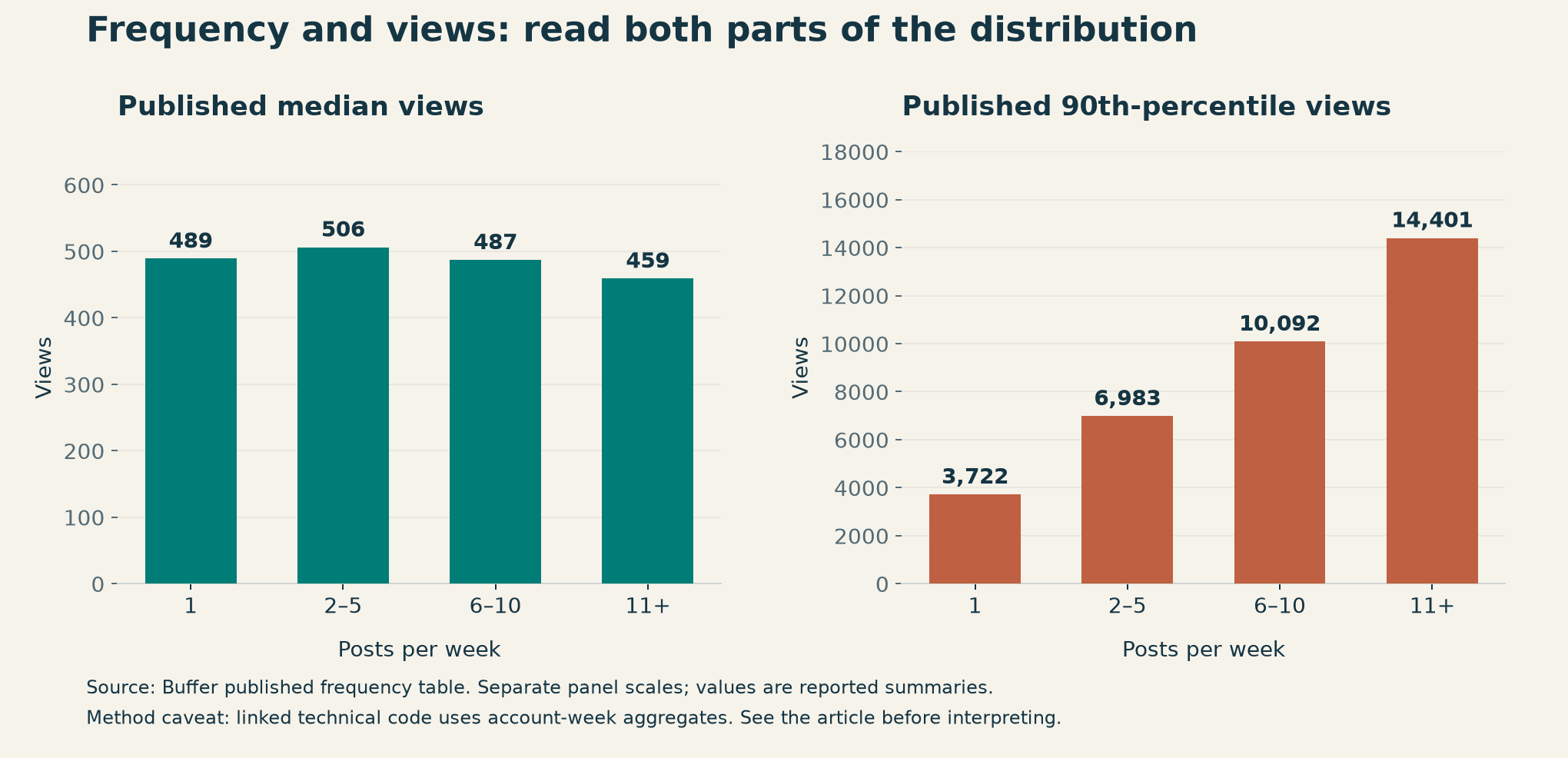
Chart redrawn from Buffer's published table; checked September 23, 2026. These are reported summary values, not predicted results for your account. The panels use different scales.
There is a useful methodological caveat. The linked technical write-up uses account-week aggregates and summarizes total_views / posts; the editorial article describes the figures as per-post statistics. Treat the displayed table as the publisher's summary, rather than a verified distribution of individual posts. Original technical analysis.
That technical analysis was published in September 2025. Its extraction uses a preceding 365-day window and active Buffer-connected profiles. Its models compare accounts with themselves over time and include a version controlling for calendar week. This improves the comparison but does not randomize posting frequency or eliminate changing content quality, topic selection, and other time-varying factors. A current headline does not make the underlying study a fresh 2026 experiment.
For your own reporting, keep these ideas separate:
- Total views describe the accumulated exposure across the posts you published.
- Median views per post describe the middle post in your chosen set, making an unusually large hit less dominant than it is in a mean.
- Upper-tail performance describes unusually strong observations. A percentile is not a personal probability of going viral.
The study gives a reason to test a manageable increase. It cannot tell you the optimal cadence for your shop. Articles repeating the same Buffer findings also remain one underlying study, however many times you encounter the numbers.
Build a four-week comparison around your capacity
Calculate the time you actually have
Assume you can spend six hours per week on TikTok. Reserve one hour for reviewing results and answering useful questions. That leaves five hours, or 300 minutes, for production.
If each finished post takes 60 minutes, your production ceiling is 300 ÷ 60 = five posts. If it takes 90 minutes, the same budget supports three complete posts, with 30 minutes left over. These are illustrative planning numbers. Log your actual time for a week before treating them as a schedule.
Count preparation, shooting, editing, captions, approval, and upload. A reusable setup can reduce the next post's cost, but do not assume all seven steps disappear when you create a variation.
Compare three posts with five
This example assumes you can make five acceptable posts inside the time budget. Use an A–B–B–A sequence over four weeks: three posts, five posts, five posts, three posts. Returning to the lower cadence gives you another observation after the higher-cadence weeks. It still does not remove seasonal, audience, or topic effects.
| Week | Cadence | Core content | Additional content |
|---|---|---|---|
| 1: A | 3 | Demonstration, buyer question, use scenario | None |
| 2: B | 5 | Same three content families | Two further buyer questions |
| 3: B | 5 | Same three content families | Two further buyer questions |
| 4: A | 3 | Demonstration, buyer question, use scenario | None |
Keep your main product, offer, and basic production standard stable. Rotate comparable topics rather than reposting an identical clip four times. Note a price promotion, holiday, stock problem, or unusually timely topic in the log.
Set a minimum quality gate before week one: the product is accurately represented, the main action is visible, speech and captions are understandable, and the viewer has one clear next step. If you cannot pass the gate, log the missed post. That is evidence about capacity.
Measure each post at the same age
Choose a seven-day observation age. Record each post's views seven days after publication, at roughly the same time of day. For a post published Monday at noon, take its reading the following Monday around noon.
Do not compare a month-old post's lifetime count with a one-day-old post. The four-week publishing plan therefore needs a fifth week to finish collecting seven-day readings for the final posts.
Use the downloadable experiment log. It includes columns for cadence, topic, minutes, publish time, observation time, views, and relevant business signals. Blank result cells are intentional: they are for your account's observations.
Decide what “worth the extra time” means before starting
For an awareness-focused shop, you might choose an illustrative decision rule: keep five weekly posts only if quality remains acceptable, production stays within six total hours, and the observed extra reach is useful enough for your goal. Set your own threshold before seeing the results.
For a sales-focused shop, qualified visits or contribution from attributed orders may matter more than views. Record the attribution definition and window separately. Avoid inventing precision when the shop gets only a few orders during the comparison.
Decide whether the extra posts earned their time
Here is a hypothetical one-week comparison showing why several measures are useful. Each post has been observed at seven days.
| Measure | Three-post week | Five-post week |
|---|---|---|
| Individual post views | 400, 500, 600 | 300, 400, 500, 600, 2,200 |
| Total views | 1,500 | 4,000 |
| Median post views | 500 | 500 |
| Mean post views | 500 | 800 |
| Total work, including one review hour | 4 hours | 6 hours |
| Views per work hour | 375 | About 667 |
The higher-output week has more total views and better views per work hour, while its median post is unchanged. One 2,200-view post drives much of the difference. Remove that one post for a sensitivity check and the other four total 1,800 views; this check explains dependence on the standout, not a replacement performance report.
Across the full plan, calculate median post views for all six A posts and all ten B posts. Compare average weekly totals across the two weeks in each condition. Keep the raw counts and a note on which topics did unusually well. Do not combine a post median, a weekly average, and a lifetime view count under one label.
Choose the next action based on the pattern:
- Extra posts repeatedly produce useful exposure within the time budget: Continue at five and keep reviewing quality and topic mix.
- The result depends on one standout: Repeat the comparison before committing more resources. Study the standout's question and execution as well as the cadence.
- Median performance or clarity deteriorates: Return to three and improve the material before adding slots.
- The team misses the quality gate or time cap: Reduce the schedule. An unsustainable plan has already failed its capacity test.
Sixteen posts are a small, noisy sample. The exercise can reveal workload and suggest a direction; it cannot establish a causal optimum or a rule for every TikTok account.
Save your chosen schedule with its reason: “Three posts fit our time budget,” or “Five produced useful additional visits in two comparisons.” That gives you a decision you can revisit. For improving the footage inside those slots, use the video editing tutorial.