
What does UGC stand for?
UGC stands for user-generated content: material people create, such as reviews, photos, videos, and posts. In a brand context, it often means content from customers or fans about a product. “User generated content” is the same phrase written without the hyphen.
A customer photographing a new backpack on a trip is a straightforward example. A buyer explaining that the strap felt uncomfortable is UGC too. Positive sentiment is not part of the definition.
The UGC meaning becomes less clear when marketers use the same label for paid creator videos and AI-generated demonstrations. Those assets can look similar in a feed while having very different origins. To understand a file, ask who made it, what relationship they have with the brand, and where it will be published.
Adobe's definition describes brand-related material created by customers, fans, and advocates, including images, videos, reviews, and social posts. In commissioning conversations, ask what the seller means by “UGC” rather than assuming the label guarantees independent customer experience.
What is UGC content in everyday use?
A product review, a forum answer, a photo of an outfit, a setup walkthrough, and a video showing a disappointing purchase can all be user-created content. Their value comes from what they help another person understand: fit, use, limitations, appearance, or experience.
For a shop, the distinction matters because “a real customer said this” makes a specific claim about the source. A casual filming style does not establish that source. A handheld video can be commissioned, and a carefully lit photo can come from an ordinary customer.
Classify content by author, compensation, and publisher
Use three fields in your content library. Keep them separate so an edit or new distribution channel does not erase the origin of the material.
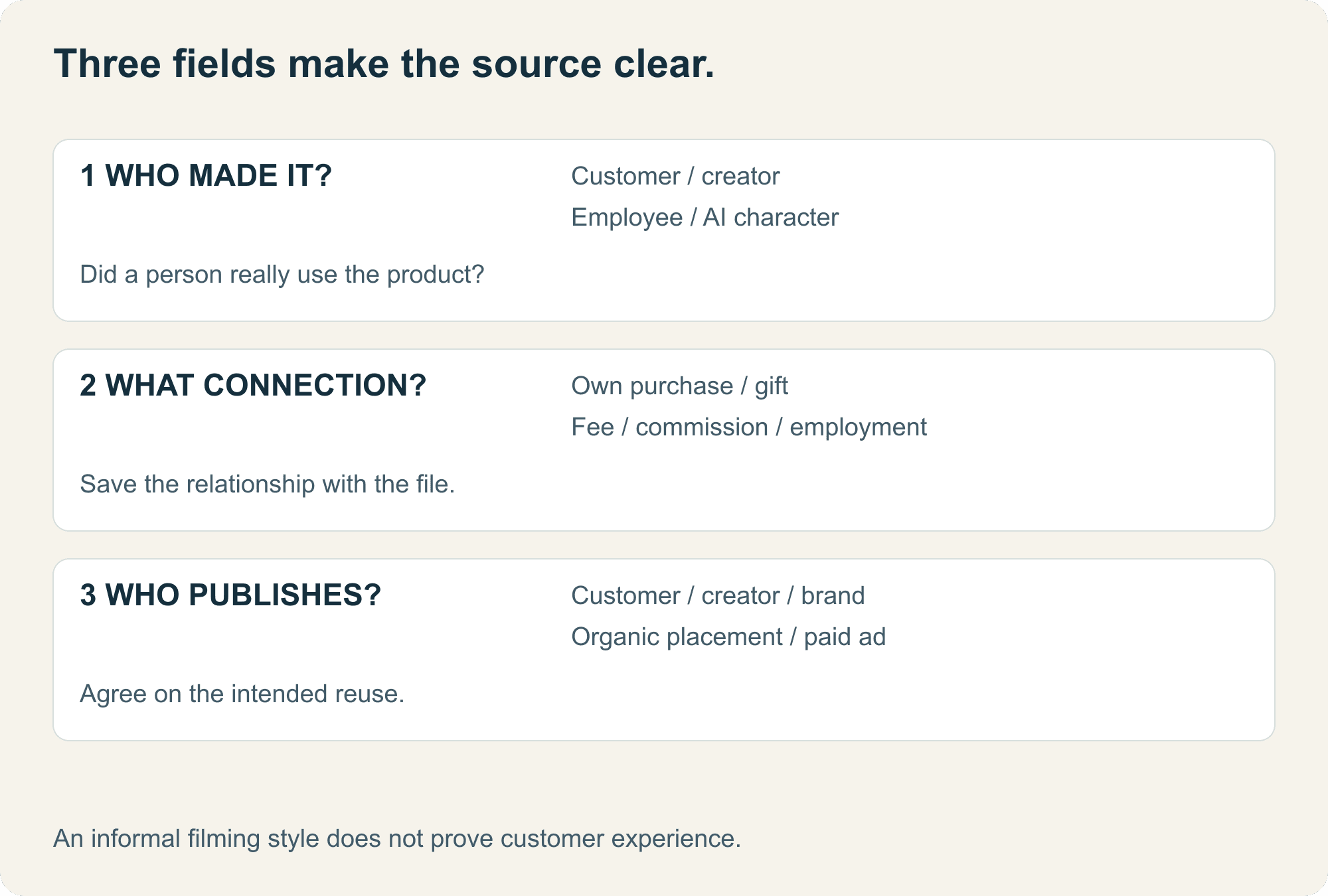
| Field | Questions to answer | Why it changes your decision |
|---|---|---|
| Author and experience | Customer, paid creator, employee, or synthetic character? Did the person actually use the product? | Determines which experience claims the content can support |
| Compensation or connection | Purchase, gift, payment, commission, employment, or another relationship? | Makes the commercial context visible |
| Publisher and placement | Customer account, creator account, brand page, email, product page, or paid ad? | Determines the distribution and usage you need to agree on |
Organic customer content describes a customer's contribution without a brand commissioning the production. Check the actual relationship before calling it independent.
Commissioned creator content is made under an agreement. It may use a conversational, everyday style often sold as “UGC.” Payment does not make a genuine observation false, but the commercial relationship should remain clear.
Influencer content commonly involves a creator publishing to their audience as part of the collaboration. One person can provide both a finished video file and a sponsored post. Those are separate deliverables with separate value.
Brand-produced content comes from the brand's own production. An employee holding a phone camera is still connected to the brand, even when the result looks informal.
These are practical working labels. They help you make a precise brief and asset record without pretending the industry uses one perfectly consistent vocabulary.
Five examples that are easy to confuse
The following situations are original hypothetical examples, created to show how the classification works. None is a customer testimonial or a real campaign result.
1. A customer posts a photo without being asked
Sam buys a backpack and posts a photo showing how it fits under a seat. Sam created the photo, paid for the bag, and published it on a personal account. The working label is organic customer UGC.
The photo may support a narrow observation about that bag, load, and seat. It does not establish that every packed bag will fit under every airline seat. If the brand wants to reuse it, document the intended use and permission before moving it into the publishing queue.
2. A customer receives a free product and shares an honest review
Maya receives a lamp from the brand and records what she likes and dislikes after using it. The author and experience are real; the free product is a commercial connection. Label the asset gifted customer or creator review, based on who Maya is.
For U.S. endorsements, the FTC explains that a free product can be a material connection that needs disclosure. An honest opinion does not automatically remove that obligation. FTC endorsement guidance.
3. A paid creator records a demonstration for the brand
Jordan is paid to film a phone stand opening and supporting a phone. The brand receives the file and posts it on its account. This is commissioned creator content. If Jordan actually performed the demonstration, the footage can show that action.
It does not establish a month of ownership. Keep the line “Here is how it opens” if accurate; remove an assigned line such as “I have relied on this for months” when that experience never happened.
4. The same creator publishes the video to their own audience
Now Jordan also agrees to publish an endorsement on a personal account. The production becomes part of an influencer collaboration as well. The publisher and distribution have changed; the original paid relationship remains.
A useful agreement names the file delivery and the public placement separately. It also states whether the brand can use the post in paid advertising and for how long. The influencer examples guide shows how to turn that distinction into a campaign brief.
5. An AI character appears in a product video
A synthetic presenter reads an explanation beside product imagery. Label this AI-generated promotional content or an AI demonstration, as appropriate. It can present verified facts. The character does not have a purchase history, personal preferences, or lived experience with the product.
A script such as “I bought this last winter and it solved my problem” would invent a customer's experience. The FTC's consumer-review guidance addresses fake testimonials, including representations by people who do not exist or did not have the stated experience. FTC reviews and testimonials guidance.
Why do people ask “what is a UGC”?
UGC usually refers to content as a category, so “a UGC” is incomplete in standard usage. The speaker often means a UGC video, a UGC creator, or a piece of UGC. In a brief, name the deliverable: “one product demonstration video with clean footage and caption text.” That gives both parties something concrete to price and review.
Check what the content can honestly prove
Before using an asset, try to finish this sentence: “This content shows ___, created by ___, under ___ conditions.” If you cannot fill it in, the missing detail belongs in your intake record.
For the paid stand demonstration, the sentence could be: “This content shows a supplied phone stand supporting the creator's phone on a level desk, filmed by a paid creator during a commissioned shoot.” That description is specific enough to help an editor avoid turning it into a universal compatibility claim.
Use this quick intake checklist:
- Identify the source. Save the original file or post and the creator's contact record.
- Record the relationship. Include gifts, fees, commissions, or employment where relevant.
- Separate facts from experience. Confirm dimensions through product evidence and experience claims with the person who made them.
- Agree on reuse. Record channels, edits, dates, and advertising permissions before handoff.
- Review the final context. A cropped image or new caption can change what the original material appears to say.
Download the content classification worksheet and apply it to one asset in your folder. If the source is a customer, preserve the customer's actual meaning. If the source is a commissioned performer or synthetic character, describe it accurately.
Once the origin is clear, the next task is execution: the UGC marketing tutorial connects the brief, permissions, files, and measurement into one workflow.