
What a useful product description needs to answer
You have a supplier sheet, product photos, and a new SKU to list. By the end of this workflow, you will have an opening, distinct selling points, specifications, care, and a clear contents list. To write that product description, collect the product facts, choose the buyer’s main task, and organize the information around the decision they need to make. Explain the useful features, make specifications easy to find, and state limitations before they become surprises.
A description is ready when a shopper can answer four questions: What is it? Is it suitable for my situation? What makes this version relevant? What else must I know before ordering?
A photograph cannot reliably answer every question. Dimensions, compatibility, included items, and care often require text. Research on descriptive text accompanying product images illustrates how a visual can leave important product attributes unclear. Give text and pictures complementary jobs.
Step 1: Build a product fact sheet
Create one source of product information before writing channel-specific copy. Assign an owner to each fact and keep the exact SKU or variant attached. Do not fill an unknown field with a likely-sounding sentence.
Here is a fictional fact packet used throughout this tutorial:
| Field | Teaching input for the Nest desk tray | Verification required for a real product |
|---|---|---|
| Product | Nest desk tray, sand color | Catalog and selected variant |
| Material | Powder-coated steel | Supplier specification |
| External dimensions | 24 × 16 × 3 cm | Measurement method and tolerance |
| Configuration | One removable divider | Physical sample and contents list |
| Care | Wipe clean with a soft damp cloth; dry after wiping | Approved care instructions |
| Included | One tray and one divider | Packaging inspection |
| Not established | Scratch resistance, recycled content, stackability | Evidence before making these claims |
The invented facts give us something concrete to write from. They do not describe a product for sale.
Save the relevant images in the same packet: an empty tray, the divider being removed, both configurations, and a dimension view. Name the variant in the file records. A photograph of a similar model can introduce an error even when the text is correct.
Download the product fact-packet worksheet. Keep unknown fields visible until the product owner resolves them.
Step 2: Choose the buyer and the main buying reason
Read customer questions, returns reasons, reviews, and support conversations you have permission to use. Look for recurring tasks and uncertainty. Separate an actual observation from an assumption.
For the teaching example, our hypothetical buyer works at a small desk and wants a designated place for pens and small items. The main buying reason is configurable organization within a known footprint. We have not conducted customer interviews for this example.
Write a brief before drafting:
Help a small-desk shopper decide whether the tray fits their space and whether the removable divider suits their items. Show the two configurations, exact external dimensions, and contents. Do not claim the finish is scratchproof.
If research instead shows that customers mainly ask whether the tray fits inside a drawer, move dimensions and measurement guidance ahead of the lifestyle explanation. Let the buying question determine emphasis.
Step 3: Turn product facts into customer benefits
Use the features, advantages, benefits framework to connect a fact to a task without stretching it.
| Fact | Direct use | Buyer-relevant explanation | Evidence |
|---|---|---|---|
| Removable divider | Use two sections or one open area | Change the layout for the items you keep nearby | Same tray shown both ways |
| External size of 24 × 16 cm | Compare its footprint with available space | Check the tray against your desk or drawer measurements | Dimension diagram |
| Wipe-clean instructions | Follow the approved cleaning method | Know how to care for the finish | Care text from the product owner |
Avoid inventing results. A divider does not establish higher productivity, and a steel body does not prove an impact rating. State the direct, useful consequence you can support.
Step 4: Write the opening, bullets, and specifications
Write an opening that identifies the product
Begin with an object and a use: “Keep pens and small desk items together in a steel tray with a removable divider.” The shopper now knows what is sold and why the layout matters.
Avoid spending the first paragraph on the brand’s mission if the immediate question is whether the tray fits. Brand context can appear where it helps evaluation.
Use bullets for buyer-relevant details
Each bullet should add a fact or explain a distinct use. Do not write five variations of “beautiful and practical.” Our tray needs a configuration bullet, a size bullet, and a contents bullet. It does not need an invented feature to make the list longer.
Keep essential specifications easy to find
Use labels and consistent units. State whether measurements are external or internal and whether accessories appear only for styling. If a fit decision depends on usable internal dimensions, obtain them; external measurements cannot stand in for that information.
Here is a complete product-page description using the fictional packet:
Nest steel desk tray with removable divider
Keep pens and small desk items together in a steel tray with a removable divider. Use two sections for smaller items, or lift the divider out when you need one open space.
- External size: 24 × 16 × 3 cm.
- Powder-coated steel in sand.
- Includes one tray and one removable divider.
- Stationery shown in the photographs is not included.
To clean, wipe with a soft damp cloth and dry after wiping. Compare the tray’s external measurements with your available space before ordering.
See the tray in both configurations.
For a real shop, the final action should link to those images or a useful configuration view. Do not add a CTA whose promised content does not exist.
Step 5: Match the copy to search intent and the page
Use the name a shopper would use for the item, then add accurate distinguishing attributes. “Steel desk tray with removable divider” communicates a more precise object than a string of overlapping terms such as “desk tray organizer office storage desk accessories.”
Check the title, selected variant, photographs, price, and description together. A page describing a sand tray while showing a black one creates uncertainty that keyword repetition cannot fix.
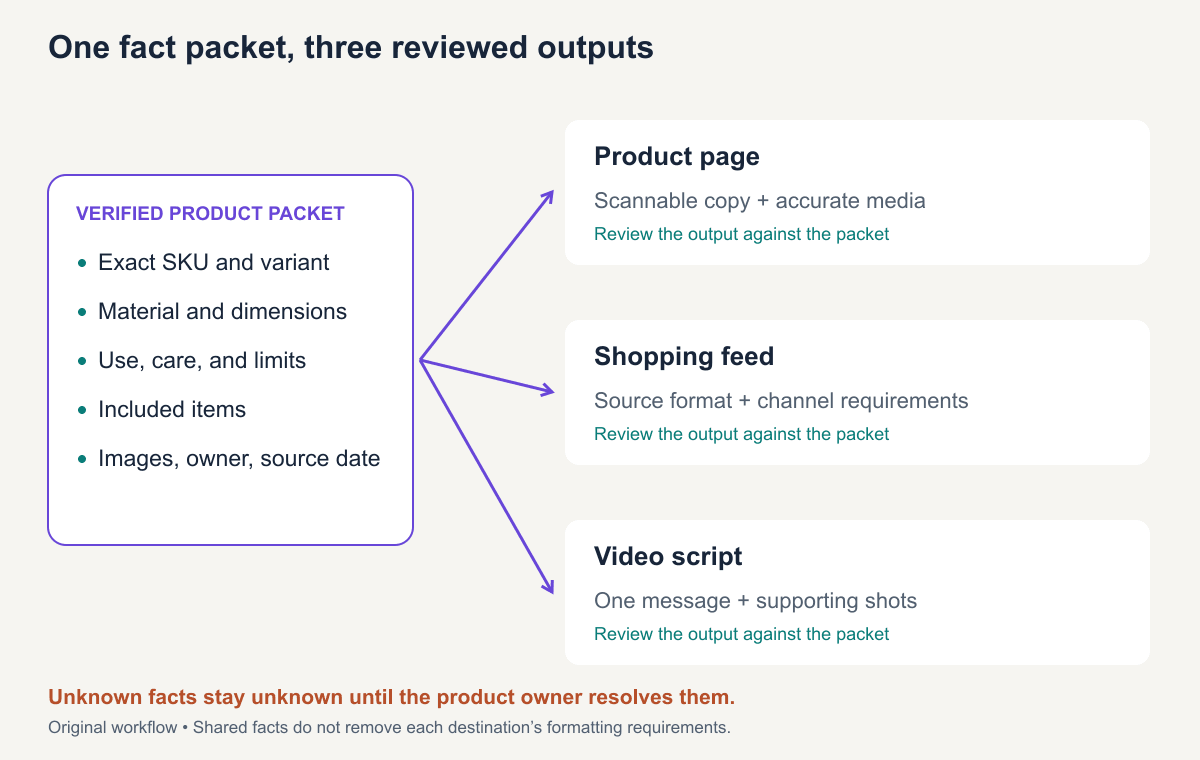
The same fact packet can supply several outputs, but each needs its own review:
| Output | What carries over | What changes |
|---|---|---|
| Product page | Identity, material, dimensions, contents, care | Scannable layout, images, selection controls |
| Shopping feed | Exact item identity and supported attributes | Feed format and destination-specific requirements |
| Short video | One supported use and the same physical product | Shot sequence, spoken language, readable text |
As checked on October 29, 2026, Google Merchant Center directs merchants to submit generative-AI descriptions through structured_description, with digital_source_type set to trained_algorithmic_media and the text in content. Check the official description specification for your source format. This is a feed attribute; it is separate from Product structured data on a web page.
For the tray’s video version, show the divider being removed and add the dimensions to a stable shot. Do not ask the image-generation or editing process to invent a different divider merely because it looks better.
Step 6: Edit for accuracy, clarity, and mobile reading
Read the draft against the fact packet line by line. Mark every claim as supported, missing evidence, or unnecessary. Remove an unsupported claim rather than softening it into an equally unsupported adjective.
Then edit for the task. Replace “transform your workspace” with what the product actually does. Split dense specifications into labeled fields. Check that important conditions remain close to the claim on a phone and do not sit only inside a distant FAQ.
Compare these versions:
| Draft problem | Revision | Reason |
|---|---|---|
| “Scratchproof storage for every desk” | “Powder-coated steel desk tray” | Scratch resistance and universal fit are unverified |
| “Large capacity” | “External size: 24 × 16 × 3 cm” | Gives a checkable measurement without inventing capacity |
| “Includes everything you need” | “One tray and one divider; stationery not included” | Removes an inclusion ambiguity |
Finally, ask someone unfamiliar with the item what is included and how they would check fit. Their explanation can reveal missing information. It is a usability check, not a sales experiment.
When the description is ready, choose one benefit to explain in video. Start a product-video brief with ReelFlock and use your checked listing as the reference for claims, variant, and destination.
When you have many listings to fix
Work on a small group of related SKUs first. Prioritize pages with concrete information gaps: repeated compatibility questions, incorrect package expectations, variant mismatches, or missing measurements. Traffic can help order the work, but an inaccurate description deserves correction even on a lower-volume item.
| Store signal | Inspect first | Useful change | Follow-up |
|---|---|---|---|
| “Does this fit my drawer?” repeats | External dimensions and measurement image | Add a labeled footprint and explain how to compare it | Check whether the question persists for the same SKU |
| Customers expect props in the box | Contents copy and styled images | Add an explicit package list and prop caption | Review related support and return reasons |
| Similar variants get confused | Selected title, specs, images, and bundle | Align each field to the exact variant | Preview each option separately |
| Many visits, few purchases | Buying information, price, stock, and delivery | Investigate the unresolved decision before choosing an edit | Track changes and outcomes over comparable periods |
Save the original and revised wording with the date. Use actual customer questions to decide the next change. Purchase rate alone cannot tell you whether the description, price, availability, or traffic was responsible.
Once the first SKU is consistent, reuse its field structure for the rest of the category. Check exceptions such as bundle contents and care before applying shared copy across a batch.
A product description template you can fill in
Use this working template with your verified data:
Product name and exact variant:
One-sentence identity and primary use:
Most relevant feature and its direct use:
Decision-critical specifications, with units:
Compatibility or fit guidance:
Included items and visible items not included:
Approved care or use instructions:
Conditions and limitations:
Next useful action and its actual destination:
Source, owner, and last verification date for each claim:
If you use an AI writing tool, constrain its role:
Draft a product description from the fact packet below. Use only supplied facts. Do not infer certifications, compatibility, performance, sustainability, or customer outcomes. Put missing decision-critical information in a separate questions list. Return an opening, distinct bullets, specifications, care, and included items. Keep the questions out of the customer-facing draft.
Review the output against the packet. A constrained prompt reduces opportunities for error; it does not verify the result. For more structures to adapt, compare the eight product description examples.
Frequently asked questions
How long should a product description be?
Long enough to resolve the important buying questions. A familiar low-complexity item may need a brief explanation and precise specifications. A configurable or compatibility-dependent item may need tables and additional guidance.
Can I reuse a supplier’s product description?
Confirm permission, accuracy, and relevance to the exact item you sell. Verify that the supplier copy describes your variant and package contents. Then organize it around your customers’ questions and your actual images.
How can I use AI without inventing product details?
Provide a verified fact packet, require unknowns to remain unknown, and review every generated claim. Keep a record of AI involvement where your publishing destination requires it. Never use generated copy to resolve a missing product specification.