
What a clothing product description should include
A shopper likes your overshirt but cannot tell whether it will fit over a tee. “Relaxed fit” gives them a starting point; a labeled measurement table and a worn-size reference help them make the decision. A clothing product description should identify the garment, explain its cut and fabric, and give shoppers enough information to choose a size and understand care. A collection story can explain the mood of a clothing line; each item still needs its own decision-critical details.
Use this checklist before drafting:
| Information | What to state | What to avoid |
|---|---|---|
| Identity | Garment type, style name, exact color | A name that hides what the item is |
| Fit | Cut through relevant areas, length, intended layering | “Flattering on everyone” |
| Fabric | Verified composition, lining, known stretch | Inferring softness or breathability from a fiber name |
| Sizing | Body chart and/or labeled garment measurements | Unlabeled numbers or an unexplained “true to size” |
| Details | Closures, pockets, adjusters, transparency where checked | Details copied from another variant |
| Care | Instructions approved for the item | Generic washing advice |
| Images | Full garment, fit reference, movement, details | A lifestyle image as the only fit evidence |
Baymard’s June 2026 apparel survey, covering 1,922 US online shoppers, reports that 48% seek size accuracy and fit details in apparel reviews. This is a self-reported information preference, not a measured conversion lift. For your listing, pair labeled measurements with real fit context so shoppers have more to evaluate than a size letter.
Describe fit and sizing so shoppers can decide
“Relaxed” describes design intention. A measurement explains the physical garment. A model reference shows how a particular size sits on one person. These pieces should work together.
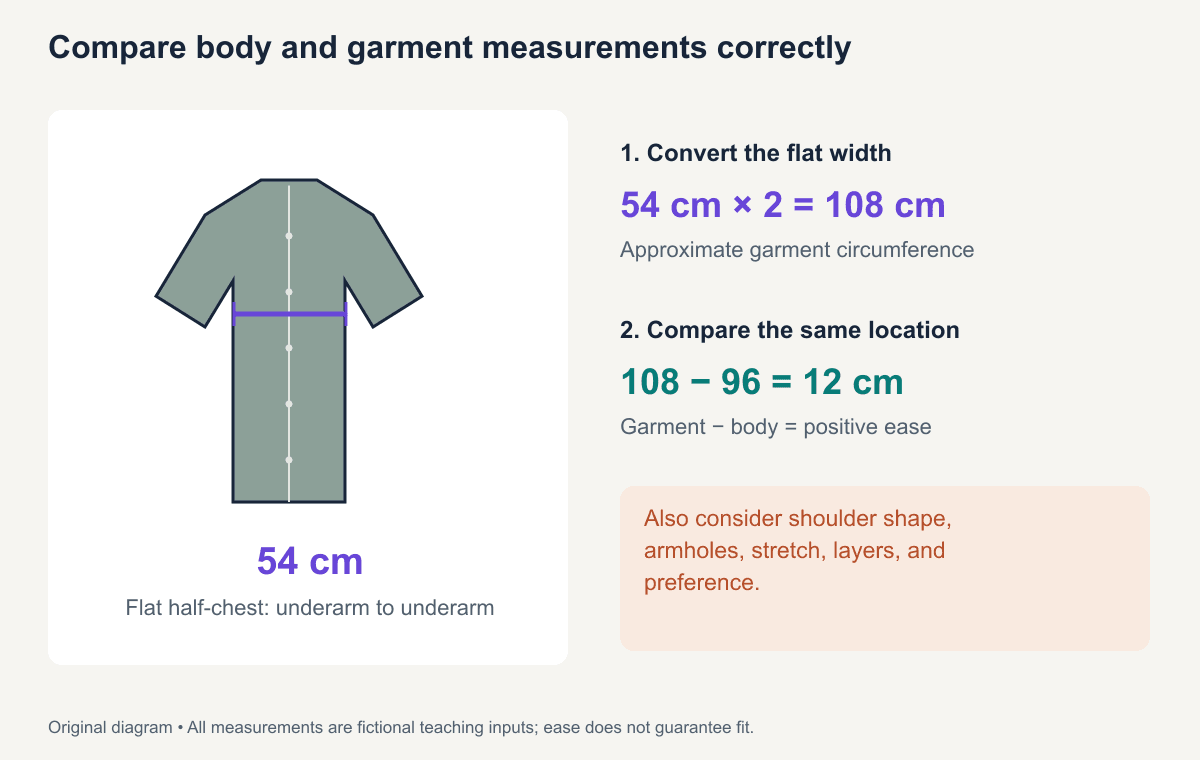
Distinguish body measurements from garment measurements. A body chest circumference of 96 cm and a garment chest circumference of 108 cm imply 12 cm of positive ease at that location: 108 − 96 = 12. That is a size comparison, not a guarantee of comfort. Shoulder shape, armholes, stretch, layering, and preferences still matter.
If a shirt is measured flat at 54 cm from underarm to underarm, its approximate circumference at that line is 108 cm. Do not compare a flat half-chest directly with a full body circumference. Publish how and where you measured.
Here is a fictional garment-measurement table for a woven shirt. All values are teaching inputs, measured with the garment laid flat and fastened, without stretching. They are not a size recommendation for a real clothing line.
| Size | Flat half-chest | Shoulder width | Back length from high shoulder |
|---|---|---|---|
| S | 51 cm | 43 cm | 67 cm |
| M | 54 cm | 45 cm | 69 cm |
| L | 57 cm | 47 cm | 71 cm |
For a real product, add measurement tolerance and the method used. Invite shoppers to compare with a garment they already like, measured the same way. A separate body-size chart should be labeled as such.
Include a model’s relevant measurements, height, and worn size only when you have accurate information and permission. “Model wears M” alone provides little basis for comparison. Do not claim that a digital model establishes real-world fit.
Explain fabric, feel, and care using verified details
Start with composition: for example, an actual supplier-approved percentage breakdown. A fiber name does not establish fabric weight, opacity, shrinkage, stretch recovery, or how the finished garment feels.
If you have inspected the item, describe the specific observation and its conditions. “The fabric has a textured surface” can be illustrated in a close-up. “The ivory sample is unlined and shown over a dark base layer” gives more useful context than “fully opaque” without a consistent check.
Keep these claims distinct:
- Composition: What the fabric is made from, verified by the item’s records.
- Construction: Woven or knitted structure, lining, closures, and seams that can be inspected.
- Feel: A sensory description grounded in the sample, with room for individual perception.
- Performance: Wrinkle resistance, shrinkage, water resistance, or moisture behavior that needs an appropriate test.
- Care: The approved instructions for the finished garment, including trims and construction.
Use the label’s care instructions. A cotton-rich garment with structured trims may need different care from another cotton-rich item. For a real catalog, store the care source with the SKU rather than deriving it from the fiber percentages.
3 clothing product description examples
The following garments and specifications are fictional. Each passage is a complete teaching description using only the facts supplied in its setup.
T-shirt: fabric, cut, and everyday use
Teaching facts: Harbor tee; navy; 100% cotton jersey; straight cut; crew neck; M flat half-chest 54 cm and back length 69 cm; approved care is machine wash cold with similar colors and line dry.
Harbor cotton jersey T-shirt — navy
A straight-cut crew-neck tee for wearing on its own or beneath an open shirt. The navy cotton jersey keeps the styling simple; compare the garment measurements with a tee you already wear to choose your preferred fit.
- Fabric: 100% cotton jersey.
- Shape: straight cut with a crew neckline.
- Size M garment measurements: 54 cm flat half-chest; 69 cm back length from high shoulder.
- Care: machine wash cold with similar colors; line dry.
Includes one T-shirt. Other garments shown are styling suggestions. View the garment-measurement table before choosing a size.
The copy avoids “preshrunk,” “breathable,” and “holds its shape” because the teaching facts do not establish those properties.
Dress: silhouette, lining, and occasion
Teaching facts: Orchard midi dress; blue; 100% viscose shell; 100% polyester skirt lining; fitted bodice, gathered skirt, side zip, adjustable straps; approved care is hand wash cold and line dry.
Orchard adjustable-strap midi dress — blue
A fitted bodice and gathered midi skirt give this blue dress a defined waist and a fuller lower shape. Adjust the shoulder straps before fastening the side zip, then check the bust and waist measurements against your preferred fit.
- Shell: 100% viscose.
- Skirt lining: 100% polyester; the bodice is unlined.
- Details: adjustable straps and a side zip.
- Care: hand wash cold; line dry.
Wear with flats for a daytime outfit or style with a jacket for an evening plan. Shoes and jacket are not included. See the length and fit photographs alongside the size table.
The styling suggestion gives context without promising an appropriate dress code for every event. Lining is described by location, so shoppers do not assume the whole dress is lined.
Jacket: construction, layering, and care
Teaching facts: Field overshirt; olive; 100% cotton twill; unlined; button front; two chest pockets; relaxed cut; approved care is machine wash cold and line dry. No weather-performance test is available.
Field cotton twill overshirt — olive
An unlined overshirt with a relaxed cut for layering over a tee. The button front lets you wear it open or closed, with two chest pockets on the front.
- Fabric: 100% cotton twill.
- Construction: unlined, with a button front and two chest pockets.
- Fit: relaxed; compare chest and shoulder measurements with a layer you already own.
- Care: machine wash cold; line dry.
Includes one overshirt. The tee shown underneath is a styling suggestion. This item has no stated waterproof or insulated rating.
Calling this “all-weather protection” would introduce a performance promise the facts do not support. The useful buying explanation is its layering format.
Clothing description templates by garment type
Use a shared set of fields, then emphasize the areas where each garment needs explanation:
| Garment | Opening emphasis | Detail fields that deserve attention |
|---|---|---|
| Tee or knit top | Neckline, cut, fabric structure | Shoulder, chest, length, care, checked opacity |
| Dress | Bodice, waist, skirt shape, length | Lining by area, closure, adjustability, bust and waist |
| Jacket or overshirt | Construction and intended layering | Chest, shoulder, sleeve, fastening, lining, tested protection |
| Trousers | Rise, seat, leg shape | Waist method, hip, inseam, stretch, closure |
For a short card, the Harbor tee might read: “Navy cotton jersey tee with a straight cut and crew neck.” The detail page adds measurements and care. A short version can omit detail when the next page supplies it; it should not replace the detail page’s fit guidance.
Download the clothing-description worksheet, including fields for each variant and the origin of each measurement.
Turn fit questions into clearer clothing copy
Start with the questions your own customers ask. These teaching examples show how the question changes the description and required media.
| Shopper question | Copy to prepare | Matching evidence |
|---|---|---|
| “Can I layer this over a sweatshirt?” | Garment chest and shoulder measurements, plus what the model wears underneath | Same size shown with the stated layer |
| “Where does the dress lining stop?” | Name the lined areas explicitly | Interior view showing the lining edge |
| “How long are the trousers?” | Inseam for each offered length, with the measuring method | Labeled length diagram and full-length view |
| “Is the pale color the same as the dark one?” | Composition, lining, and construction for each actual variant | Separate images and label checks |
A reply such as “choose your usual size” leaves the comparison undefined. Give shoppers the measurement method and relevant product details first. When you include genuine fit reviews, keep their size and context intact; one person's experience cannot establish fit for everyone.
Keep your clothing line consistent across SKUs
Define a small vocabulary for cuts and measurement methods. Use “back length from high shoulder” consistently if that is your method. Do not quietly switch to center-back length in another SKU’s table.
Keep a variant exception record. A color may use a different composition, a pale version may have a different lining, and one run may change a trim. Copy can share a structure while those facts remain item-specific.
Review a selection of pages after every batch: title against variant, text against label, table against measurement sheet, and photographs against the actual garment. Generic collection language belongs on the collection page, not in place of individual specifications.
Pair each description with the right product images
Match each uncertainty to the evidence that resolves it:
| Question | Useful asset | Text to keep nearby |
|---|---|---|
| Where does the hem sit? | Full-length front, side, and back views | Worn size, accurate model reference, garment length |
| How does it move? | Walking, sitting, or arm movement | What size is shown and any relevant fit limitation |
| What is the texture? | Detail view in consistent light | Composition and construction |
| Is it lined? | Inside view | Exactly which areas are lined |
| What changes between sizes? | Labeled measurement diagram | Method and size-specific measurements |
A short video can reuse this evidence in a fit walkthrough. Keep the garment’s color and proportions consistent during editing. For a batch of useful content from the same item, use the fashion content creation workflow.
For a video introducing the garment, draft the script with ReelFlock. Use your checked clothing description for the facts and your real fit footage for the demonstration.
Frequently asked questions
How do I describe a garment when I cannot verify the fabric feel?
Publish the verified composition and construction. Request a sample or a reliable product assessment before adding sensory claims. A photograph cannot establish how soft the fabric feels against skin.
What is the difference between a clothing line description and a product description?
A line description explains the collection’s audience, style, and relationship between items. A product description helps someone evaluate one specific garment, variant, and size.
Should every color and size have different copy?
Share accurate common information. Change the variant name, size measurements, composition, lining, care, and images wherever they differ. Do not create different promises solely to make the copy look unique.