
What fashion content creation includes
You have one overshirt to promote and need more useful material than another outfit transition. Fashion content creation turns that garment, its fit, styling choices, and product details into photographs, videos, and written posts that answer different shopping questions. A workable content plan helps a defined audience answer real questions: how an item looks, how it fits, how to style it, or what to check before buying.
For a clothing seller or a creator working with the brand, every brief should name the featured SKU, the shopper question, and the next useful action. Styling can introduce a look; fit and construction content help someone evaluate the item. Keep personal styling opinions distinct from measurable product facts.
This tutorial uses a fictional olive cotton-twill overshirt to show a repeatable process. Its teaching facts are: unlined, relaxed cut, button front, and two chest pockets. It has no verified waterproof, thermal, or fit-performance claims.
Choose your audience, style, and content pillars
Start with a situation you can serve. “People who like clothes” is difficult to plan for. “People building simple workday layers from a small wardrobe” gives you questions about combinations, fit, repeat wear, and care.
Choose three or four pillars that match both those questions and your access to evidence:
| Pillar | Viewer’s need | Recurring content |
|---|---|---|
| Styling | Make an outfit decision | One garment several ways, occasion comparisons |
| Product understanding | Inspect an item before choosing | Fit walkthroughs, details, inside views |
| Questions | Resolve a practical uncertainty | Measurements, care, layering comparisons |
| Trust and story | Understand who made or uses the item | Actual process, permissioned customer looks |
Define a visual approach you can repeat: consistent background, readable garment shape, accurate color, and captions that explain the styling choice. A style rule should help people recognize the work without hiding the product.
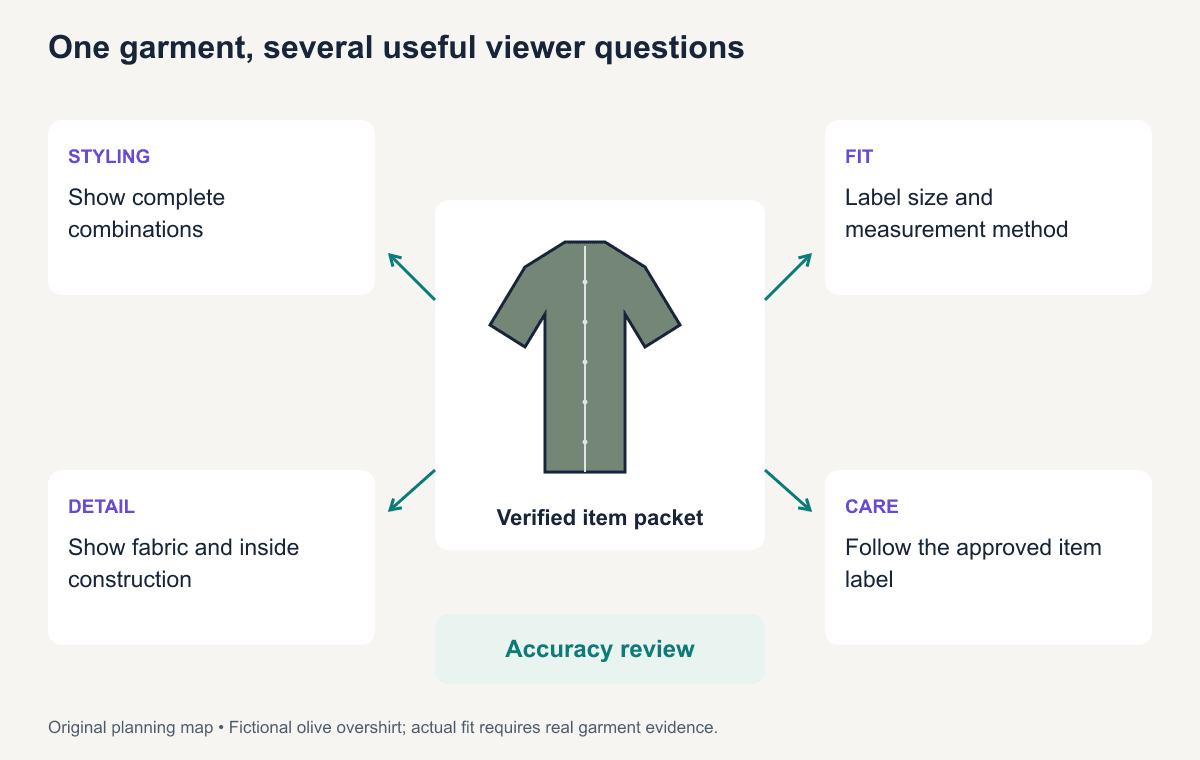
Choose the next idea from a buying question
| What your shopper needs | Start with these ideas | Useful next step |
|---|---|---|
| Inspiration for an unfamiliar item | Three-way styling; two occasions; capsule grid | Inspect the featured garment or save a usable outfit |
| Help deciding fit | Fit in motion; sizing answer; controlled comparison | Compare the garment measurements |
| More product detail | Fabric close-up; inside view; making-of explanation | Read composition, construction, and care |
| Confidence from relevant experience | Genuine customer looks with fit context | Inspect the item and accurate customer notes |
Baymard’s 2026 apparel survey identifies fit details as a leading reason shoppers read apparel reviews. Use that as a prompt to investigate your own unanswered sizing questions. A content calendar needs room for those answers alongside outfit inspiration.
12 fashion content ideas to adapt
Each brief below includes the question, shots, proposed words, and next step. The wording is original teaching copy. Use verified garment details and an available destination when making a real version.
1. One item, three ways
For: Someone trying to reuse a garment. Question: Can this overshirt support different outfits?
Capture three full-length looks at matching scale: open over a tee, buttoned with trousers, and worn as a middle layer beneath an appropriate coat. Show the change that creates each look. Proposed line: “Keep the overshirt; change the layers around it.” End with “Save the three outfit combinations.” State which pieces are styling suggestions and which item is being featured.
2. Two occasions, one layer
For: A viewer moving between informal work and a weekend plan. Question: What styling changes the impression?
Film two complete outfits with the same overshirt, then close-ups of the changed shoes and base layer. Proposed line: “Same layer, different finishing pieces.” End with “Compare the two full looks.” Present this as a styling opinion, not a guarantee that the outfit meets every workplace dress code.
3. A small capsule combination grid
For: Someone planning repeat combinations. Question: How many visually distinct outfits can these actual items make?
Lay out one overshirt, two tees, and two trousers. Show all four tee–trouser pairings with the overshirt. Proposed line: “Two base layers and two trousers give four combinations to inspect.” End with “Save the combination grid.” The arithmetic is four candidate pairings, not proof that all four fit the person’s needs.
4. A fit walkthrough in motion
For: A shopper evaluating shape. Question: What does this size look like standing, sitting, and moving?
Capture front, side, back, an arm raise, and a seated view. Add accurate model reference and worn size, with permission. Proposed line: “Here is this size from every angle, over the same tee.” End with “Compare the garment measurements.” One person’s demonstration does not establish fit for all bodies.
5. Fabric details without invented feel
For: Someone inspecting construction. Question: What can I see about this fabric and finish?
Show a stable twill close-up, a seam, and the inside of the unlined garment. Proposed line: “A closer look at the cotton twill and unlined construction.” End with “View composition and care.” Do not infer softness, breathability, or weather resistance from the close-up. If describing feel from a sample, identify it as an observed sensory description.
6. A care-label walkthrough
For: An owner checking how to care for the item. Question: What does this specific garment’s label instruct?
Film the actual label in focus and demonstrate only approved steps. Proposed line: “Here is how the care label says to wash this overshirt.” End with “Save the care reference.” Obtain the approved instructions first; the fictional overshirt’s composition alone does not supply them.
7. A sizing answer with a measurement
For: A shopper comparing sizes. Question: Am I comparing the right measurement?
Show a shirt laid flat, the underarm-to-underarm line, and the table’s label. Proposed line: “A flat half-chest and a body circumference are different measurements.” End with “Check the size table’s method.” Use the clothing description guide for a labeled example and ease calculation.
8. A styling adjustment, explained
For: Someone who likes the garment but dislikes one outfit. Question: Which small change affects the silhouette?
Keep the camera fixed. Show the overshirt fully buttoned, then open, with the same base outfit. Proposed line: “Opening the front changes the visible lines of this outfit.” End with “Which version suits your styling goal?” Avoid presenting body-shaming rules or a personal preference as a universal correction.
9. A fair outfit comparison
For: A viewer choosing between two combinations. Question: What changes when the base layer changes?
Show the same garment, person, light, camera position, and trousers with two different tees. Proposed line: “Only the base-layer color changes here.” End with “Compare the looks side by side.” If several elements change, identify them; otherwise the visual does not support the claim about one styling variable.
10. A real making-of explanation
For: Someone interested in product decisions. Question: Why was this detail chosen?
Record the actual designer or maker explaining one documented choice, such as pocket placement. Show the corresponding sample or process. Proposed interview prompt: “What task did this detail need to support?” End with “See the finished detail.” Do not invent a quote or stage unrelated workshop footage as the manufacturing process.
11. Permissioned customer looks
For: A shopper seeking different styling perspectives. Question: How do other people wear this item?
Use customer images with permission and appropriate relationship disclosures. Identify the item and size only when accurate and allowed. Invite a genuine explanation of the styling choice. End with “Explore the customer outfit notes.” Do not turn an edited caption into a claim the customer did not make.
12. A collection story grounded in details
For: Someone deciding whether the line fits their wardrobe. Question: What connects these pieces?
Show the real items together, then highlight a documented repeated color, proportion, or construction choice. Proposed line: “These pieces share an olive-and-navy palette; here is how they pair.” End with “View the pieces and their measurements.” A mood board can express an intention; it cannot establish garment composition, fit, or production origin.
Turn one garment into a week of content
Capture an evidence packet before writing seven separate posts: full views, actual worn-size reference, movement, construction details, inside view, and the approved care label. Those assets can support several useful questions without requiring a new shoot every day.
This example publishes three pieces in a week and uses the other days for preparation and review. It is a capacity plan, not a recommendation that every account follow the same cadence.
| Day | Work or publication | Question and opening | Required shots | Action |
|---|---|---|---|---|
| Monday | Prepare facts and capture | What can we accurately show? | Fit, detail, inside, styling | Resolve missing product information |
| Tuesday | Publish three-way styling | “Keep the overshirt; change the layers.” | Three full looks and transitions | Save the combinations |
| Wednesday | Edit fit answer | Does this size suit a similar layering preference? | Front, side, back, motion | Verify size and model labels |
| Thursday | Publish fit walkthrough | “Here is this size over the same tee.” | Approved fit sequence | View garment measurements |
| Friday | Publish construction detail | “A closer look inside the overshirt.” | Twill, seams, unlined interior | View composition and care |
| Weekend | Review and collect questions | What is still unclear? | No new capture required | Choose the next brief |
Download the fashion brief and batch-planning worksheet. Keep the viewer question, factual source, shot IDs, and next step together.
For a recurring garment-video batch, explore ReelFlock’s product-to-video workflow. Use the garment’s verified details and your weekly briefs to assess how it fits your production process; keep actual fit evidence in the review.
Prepare and capture fashion content
Check the item’s actual variant, labels, closures, and condition. Remove accidental distractions while preserving the garment’s real construction. Use consistent light, and compare the captured color with the physical item. A screen and lighting setup can alter color perception; avoid filters that materially change what shoppers think they will receive.
Frame full-length views so hems, sleeves, and shoes are not accidentally cut off. Keep the camera position stable for comparisons. Show front, side, and back when fit matters, and leave enough time to observe movement.
Capture detail views separately. Texture, pocket construction, lining, and closures each need a view that answers their specific question. Label props and other garments when there is a risk of confusing what is sold.
Edit and adapt the content for its destination
Choose the sequence around the question. A fit video should reach the fit views quickly; a styling comparison should preserve matched framing. Add captions for speech and concise labels for size, garment, or construction.
Check important labels in the placement preview and at phone size. TikTok’s creative guidance recommends communicating the proposition early and paying attention to interface safe areas. Use that as a context-specific starting point, then verify whether the viewer can understand this particular garment.
Repurpose the evidence for product pages or carousels where useful. The same image may need a different crop, caption, or destination instruction. Preserve the information that makes a comparison fair.
Keep product details and styling claims accurate
AI-assisted layouts can help explore a content idea, but generated bodies, drape, and garment details cannot verify real fit. Use actual, approved garment evidence for product decisions. Review every edited asset for changes to pattern, buttons, proportions, color, and text.
Maintain a claim record for composition, care, measurements, origin, and any performance statement. Styling suggestions can be subjective; product facts should remain traceable. Keep the distinction clear in captions and on the destination.
Review performance and plan the next batch
Match the review to the task. Styling saves may indicate that viewers want to return to a combination; they do not establish a purchase. Fit questions can expose missing information even when a video has modest reach. Product visits and orders need consistent definitions and attribution windows.
Record the actual question behind comments. “What size is this?” can become a better worn-size label; “Is it lined?” can become an inside-view answer and a product-description update. This closes the loop between content and the information shoppers need.
Keep a small feedback record that connects the comment to both the next video and the product page:
| Question or confusion | Next content piece | Store information to update |
|---|---|---|
| “What size is the model wearing?” | Fit walkthrough with accurate labels | Worn size and permitted model reference |
| “Does it have a lining?” | Open-garment inside view | Lining by area in the description |
| “Can I wear it over a thicker layer?” | Same garment shown with the stated base layer | Measurements and the exact demonstration context |
| “Are both pieces included?” | Outfit breakdown naming each item | Bundle contents and styling-prop captions |
Prioritize one repeated question for the next batch. When a video supplies a clearer answer, update the relevant listing too so the buyer encounters consistent information after clicking.
Use the short-form marketing plan to keep metrics comparable and the video script template when an answer needs a clearer sequence.
Frequently asked questions
How do I start creating fashion content with a phone?
Choose one garment and one useful question. Use stable framing and consistent light, capture the needed views, and add accurate product and size labels. Review a short test before committing to a larger batch.
Can a small brand create content without a studio?
Yes, when the environment allows clear, accurate product representation. A simple background and controlled setup can support fit and detail content. Be explicit about any limitations of the footage.
How do I keep producing ideas for the same products?
Return to unresolved questions: fit, combinations, construction, care, and use. Reuse a verified evidence packet to answer different questions. Stop adding variations when they repeat information without helping the audience.