
What is short-form video marketing?
Your store has posted several clips, but views alone do not tell you which product question to answer next. Short-form video marketing uses compact videos to support a defined selling task: introduce a product, answer a buying question, show a use, or help someone take the next step. A useful strategy connects audience questions, repeatable formats, available evidence, and measurement.
“Short-form” is a planning category, not one universal platform limit. YouTube currently supports qualifying Shorts up to three minutes; check its official classification guidance for format and upload rules. A technical maximum is not a recommendation that every message should fill it.
For a small team, start with one audience and a few questions you can answer accurately. A stream of unrelated trending clips makes it difficult to understand which content actually helps people evaluate your product.
Choose a goal before choosing a video format
Write the decision you want the viewer to make, then choose an observable indicator. Keep the metric’s denominator and scope visible.
| Goal | Content task | Useful indicator | What it cannot establish alone |
|---|---|---|---|
| Awareness | Make the product and use recognizable | Reach and a direct comprehension check | Purchase intent or sales |
| Product understanding | Explain a mechanism or answer a question | Relevant watch behavior, question resolution | That everyone understood the demonstration |
| Consideration | Help someone inspect suitability | Qualified product visits, size-guide use | That the item suits every visitor |
| Action | Help a shopper complete an order or a requested product alert | Orders or completed alerts under a defined reporting window | Incremental sales without an appropriate comparison |
For a fictional desk-tray business, the initial goal might be reducing confusion about the removable divider. The first video should show it being removed and explain the two layouts. A founder montage would serve a different task.
Assign one primary goal per video and one learning question per batch. “More views” is too broad to diagnose what the next batch should change.
Choose where your audience will watch
Use evidence from your own customers and account history where available. Ask where people encounter the product category, which formats they use to evaluate it, and whether a usable next step exists in the placement you can access.
TikTok, Reels, and Shorts can each carry demonstrations, answers, or stories. Do not assign an entire platform a single audience stereotype. Choose a primary channel your team can publish and review properly, then adapt useful material for a second channel if capacity allows.
Confirm current requirements for the exact placement: aspect ratio, duration, text safe area, audio rights, links, and any commercial features. TikTok’s creative guidance offers platform-specific starting points. Account, region, and placement access can affect the actions viewers can take.
Do not build a closing instruction around a shopping link or feature you have not verified on the actual account. A video should tell people to do something that is possible where they see it.
Match each video to a store destination
Map the viewer question to the place where they can continue evaluating the product. This works for a store product page or a supported in-app shopping destination; verify the actual account and placement.
| Video question | Next useful information | Destination to check |
|---|---|---|
| “What is this?” | Product identity and the main use | The featured SKU with matching images |
| “Will it fit?” | Measurements, method, and variant choices | The same item with an accessible size or dimension guide |
| “What is included?” | Exact bundle contents | The featured package, not a similar bundle |
| “Why this version?” | Differences and tradeoffs | A valid model or configuration comparison |
A fit-focused video that lands on an unrelated collection creates work for the shopper. Fix that connection before increasing the number of edits. Record the destination with the brief so it travels with every channel version.
6 short-form video formats to build around
1. Product demonstrations
Question: How does the product work? Example: Show a real tray’s divider being removed in one continuous action, then show both layouts. Evidence: The actual product and a clear view of the mechanism. Review: Can a viewer explain the two configurations afterward?
Avoid cutting away at the moment that needs proof. A highly edited reveal may look good while leaving the mechanism unclear.
2. Problem-and-solution videos
Question: Does this address a task I recognize? Example: A small desk has limited space; show how to compare the organizer’s footprint with available room. Evidence: Accurate measurements and a realistic setup. Review: Do visits or questions concern fit, or did the opening attract an unrelated audience?
Do not exaggerate the problem to make the product appear necessary. Show a plausible task and its tradeoffs.
3. Customer questions and answers
Question: What would stop someone buying? Example: “Are the stationery items included?” Show the package contents and label props separately. Evidence: The exact contents list. Review: Track whether the same confusion persists in comments and support, while allowing for changes in audience size.
Use real recurring questions when available. If the question is an editorial hypothesis, do not present it as a customer quotation.
4. Customer-led content
Question: How does another person use this? Example: A customer explains their own desk arrangement, with permission and any required disclosure. Evidence: Their actual experience and the depicted product. Review: Look for useful follow-up questions and qualified interest.
Do not script a fabricated testimonial or imply one person’s result is typical without evidence. An actor reading teaching copy should be identified appropriately.
5. Behind-the-scenes videos
Question: What explains a design or production choice? Example: A maker shows how they check a divider against the tray. Evidence: The actual process and a knowledgeable explanation. Review: Does the video improve understanding of the choice, rather than merely show unrelated activity?
Keep the claim within what the process demonstrates. A workshop clip alone does not establish environmental performance or lifetime durability.
6. Practical tips and comparisons
Question: How should I decide? Example: Compare the tray’s two layouts using the same items, camera angle, and scale. Evidence: A consistent setup and labeled measurements. Review: Inspect product-page visits and the questions people ask next.
State tradeoffs. Two layouts can suit different uses without one being universally superior.
Build a repeatable planning and production workflow
Keep a question queue with five fields: question, audience situation, evidence available, proposed format, and next action. Prioritize questions that matter to the buying decision and can be answered using assets you can actually produce.
Turn each selected question into a brief, then a script and asset list. Group filming by setup: all overhead demonstrations, all detail views, then any presenter sections. Capture enough context for later edits without pretending one shot proves every claim.
Name files by product, variant, shot, and version. Keep the claim source beside the asset record. When a measurement changes, you should be able to find every graphic and script that uses it.
Use a review gate before scheduling: factual accuracy, visible evidence, readable text, usable next step, and rights. Batch size should follow your team’s available production and review time. A manageable recurring batch is more useful than an ambitious frequency that eliminates review.
If producing the next product-video batch is your bottleneck, see how ReelFlock connects products, scripts, and video production. Use one SKU and the next batch from your plan to assess the workflow.
Adapt content for each channel
Reuse the raw evidence, then review the edit. Opening pace, crop, captions, ending instruction, and available destination may need to change. Do not simply carry over an instruction that refers to another platform’s interface.
Preview in the actual placement where possible. Important product parts and text must remain visible around interface elements. If a platform’s music library does not grant the rights required for another destination, use appropriately licensed audio or replace it.
For educational content, preserve the complete explanation even when shortening. For a purchase-focused cut, keep the conditions that materially affect the offer. A shorter edit should not become a less accurate one.
Measure attention, action, and business outcomes separately
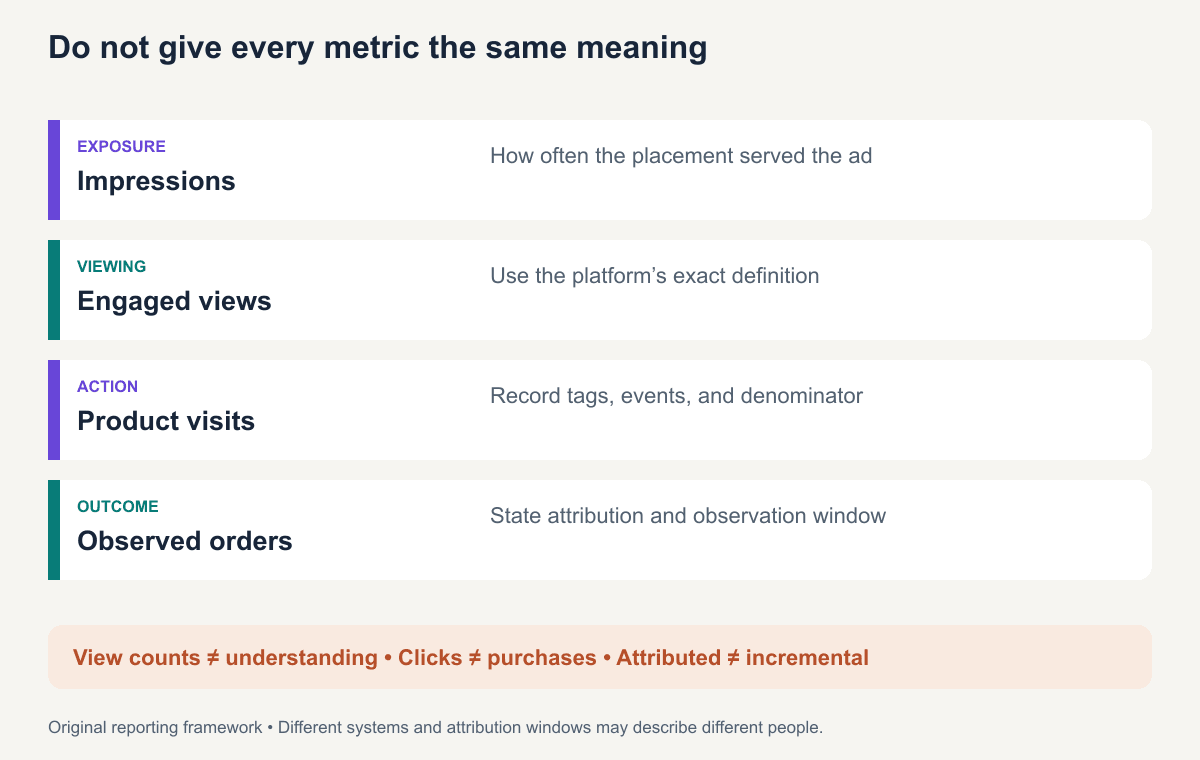
YouTube changed Shorts view counting on March 31, 2025: views count starts and replays without a minimum watch-time requirement, while “Engaged views” preserves the earlier engagement-focused measure. See YouTube’s current explanation. That makes a time series crossing the change—and a comparison with another platform’s views—easy to misread.
Define your own reporting dictionary before comparing videos:
| Field | Record explicitly |
|---|---|
| Views | Platform definition, date range, organic or paid |
| Watch measure | Metric name, duration basis, whether looping affects it |
| Clicks | Link location, unique users or events, eligible denominator |
| Product visits | Analytics definition, tagging, attribution window |
| Orders | Observed or attributed, window, cancellations and returns |
| Spend | What costs are included and the reporting currency |
Consider this invented teaching dataset from two comparable, hypothetical paid test cells. Counts are illustrative and do not establish statistical reliability:
| Cut | Impressions | Link clicks | Observed attributed orders | Spend | Click rate | Spend / attributed order |
|---|---|---|---|---|---|---|
| A: layout first | 10,000 | 200 | 10 | $100 | 2.0% | $10.00 |
| B: dimensions first | 10,000 | 300 | 9 | $100 | 3.0% | $11.11 |
B has more clicks but fewer observed orders in this sample. That is a reason to inspect the destination and audience fit, not declare the opening a sales winner. Attributed orders are also not automatically incremental orders caused by the ad. Margin, refunds, and longer-term effects remain outside this table.
Download the four-week planning worksheet, the metric-definition sheet, and the fictional comparison dataset. Keep metric definitions attached to the numbers so a later platform change does not silently change the story.
Put acquisition cost beside the margin available to pay for it
For a purchase campaign, calculate the contribution available before advertising from your own order data:
net sales revenue − product cost − payment fees − fulfillment and shipping subsidy − expected returns cost
In a fictional example, net sales revenue is $40 and those variable costs total $28. That leaves $12 per order before advertising, fixed overhead, and profit. A $10 attributed acquisition cost would leave $2 under these assumptions. Confirm that discounts, taxes, refunds, and return costs are handled consistently and counted once.
This is a planning calculation, not a recommended target or proof of incremental profit. Use it to decide whether a creative test is economically plausible; set any target below that ceiling according to the costs and profit your business must cover. Download the order-economics worksheet to replace the fictional inputs with your own records.
Decide what to fix after a batch
| Observation | Inspect next | Useful follow-up |
|---|---|---|
| People leave before the product appears | Opening and time to product identity | Lead with the use or mechanism |
| Viewers watch but ask basic product questions | Missing evidence or unclear labels | Answer one unresolved question in the next cut |
| Product clicks rise but orders do not | Message match, price, stock, delivery, and checkout | Check the destination before attributing the change to the hook |
| Orders arrive but contribution is weak | Net revenue, costs, returns, and attribution | Reassess the economics before increasing spend |
Treat these as investigation paths. Organic posts and small batches give directional evidence; they do not isolate creative effects from distribution and other changes.
A four-week short-form video plan
This is a capacity example, not a posting-frequency benchmark. It assumes a small team can produce and review two videos per week. Reduce the batch if evidence or review time is limited.
| Week | Publish | Keep stable | Learning question | Next decision |
|---|---|---|---|---|
| 1 | Divider demonstration; contents answer | Product, destination, clear labels | Do people understand what the product includes? | Fix missing information before adding variants |
| 2 | A fit question; a layout comparison | Product facts and measurement method | Which questions produce relevant follow-ups? | Prioritize the unresolved buyer question |
| 3 | Two openings for the strongest useful topic | Main demonstration and ending | Does the opening change qualified response? | Review attention and downstream action separately |
| 4 | Improved explanation; follow-up answer | Definitions and reporting window | What confusion remains, and what is now supported? | Retain, revise, or stop the format with reasons |
Record the distribution context for every post. Organic posts published on different days do not create a clean causal test of an opening. Use the results as directional learning unless the design supports a stronger conclusion.
When the next batch is selected, turn its briefs into marketing scripts and use the commercial production guide to plan capture and review.
Frequently asked questions
How long should a short-form marketing video be?
Long enough to communicate one useful point accurately within the placement’s limits. Test whether viewers can follow the demonstration. Neither a platform maximum nor a general average determines the right length for every message.
How often should a small team post?
Choose a cadence you can sustain with accurate facts, usable footage, and review. Estimate the time per batch, including revisions and measurement. Increase volume only when the workflow can maintain quality.
Can the same video work on TikTok, Reels, and Shorts?
The core explanation may transfer. Review crop, text, audio rights, ending instruction, link access, and measurement definitions for each destination before reusing the export.