
Product description examples at a glance
If your listing has attractive photographs but shoppers still ask what is included or which version to choose, the description has a specific job left to do. A useful product description helps a shopper identify the item, understand its use, and resolve those buying questions. The most useful structure depends on the question: a coffee buyer needs different information from someone measuring a patio for a grill.
In Nielsen Norman Group’s ecommerce usability research, incomplete or unclear product information accounted for 20% of the task failures observed. That finding comes from its 2014 product-description article; it is not a current market-wide abandonment rate or a promised conversion lift.
The eight examples below analyze information choices on official brand pages checked on October 29, 2026. They are editorial readings, not controlled tests of which copy sells best. Descriptions are paraphrased rather than reproduced.
| Example | Useful writing choice | Best fit for your own product |
|---|---|---|
| Verve Coffee | Separate tasting character from basic identity | Sensory products |
| HELM Boots | Explain materials and construction | Products shoppers inspect for workmanship |
| Califia Farms | Connect the product to specific uses | Ingredients and preparation products |
| Revlon | Link controls and design to use | Tools with several operating choices |
| Levi’s | Make fit language concrete | Clothing with closely related cuts |
| Clorox | Keep conditions close to the claim | Products whose result depends on correct use |
| KIND | Identify the exact variant and serving facts | Foods with similar names and different formulations |
| Weber | Describe the space the product occupies | Large or installed products |
8 product description examples, annotated
1. Verve Coffee: distinguish tasting notes from ingredients
Verve’s Streetlevel page presents a roast level and tasting notes alongside the coffee’s identity. Notes such as clementine and honeycomb help a buyer imagine flavor without making the description a list of technical coffee terms.
What it answers: What kind of coffee is this, and what sensory experience is the brand describing?
What to borrow: Put product identity first, then use a small, specific sensory vocabulary. Keep preparation, roast, origin, and bag options easy to find.
What to improve in your own version: Label tasting notes clearly so a shopper does not read them as added ingredients. If your product contains added flavorings, describe those separately. A flavor illustration should not create a false impression about the ingredients.
2. HELM Boots: give construction details a job
HELM’s Hollis Black page identifies leather and construction details rather than relying entirely on a heritage story. Width options also matter to someone deciding whether to buy a boot online.
What it answers: What is this made from, how is it built, and what fit choices are available?
What to borrow: Pair each technical detail with its practical meaning. If a construction term matters, explain what it allows the wearer or repairer to do and substantiate that explanation.
What to improve in your own version: Add a labeled detail image and a direct route to the current size guidance. Do not turn a named leather or construction into a lifetime durability promise. A material specification and a tested lifespan are different kinds of evidence.
3. Califia Farms: show the intended preparation
Califia’s Oat Barista Blend page connects the drink to coffee preparation, including frothing and use in hot or cold drinks. The description helps a shopper picture a task rather than merely encounter an ingredient list.
What it answers: What would I use this for, and where do I find the nutrition and ingredients?
What to borrow: Name the preparation and show it. “For frothing into a latte” is easier to act on than “perfect for every moment.” Keep dietary, allergen, and ingredient information in their own accurate fields.
What to improve in your own version: Add a short preparation sequence using the actual product. Avoid unsupported comparisons with dairy or a competing oat drink. The demonstrated recipe should match the instructions and serving context.
4. Revlon: explain the controls before promising results
The official One-Step Volumizer PLUS page lists a 2.4-inch oval head, four heat settings, and a detachable head. Those are concrete details a buyer can compare.
What it answers: What is the tool’s form, what can I adjust, and how can it be stored?
What to borrow: Group physical design, controls, and handling information. Translate the feature into a visible use without claiming a universal styling result.
What to improve in your own version: Keep the conditions for any numerical performance claim beside that claim, with its test source. We are not using the brand’s shininess or speed percentages as independent performance evidence here. A control demonstration and a comparative hair-result test answer different questions.
5. Levi’s: clarify the differences between familiar names
Levi’s guide to women’s 501 fits explains how related styles differ in rise, seat, and leg shape. It is a companion fit guide rather than a single-SKU description, but its attribute-based language is useful on product pages.
What it answers: How does this cut differ from another style with a similar name?
What to borrow: Describe the garment’s fit through relevant body areas and explain where it sits. “Straight leg” and a clearly stated rise provide more direction than “a flattering silhouette.”
What to improve in your own version: Link the description to exact garment measurements, a model reference, and the selected wash’s composition. Do not apply a fabric statement from one 501 variant to every product carrying that name. Use the clothing description guide for a complete fit table.
6. Clorox: keep usage conditions with the result
Clorox’s Disinfecting Wipes page provides product uses and directions. This is a useful example of copy where conditions are essential to understanding the claim.
What it answers: What is the product intended for, and what instructions govern that use?
What to borrow: Keep the claim, applicable surfaces, and directions connected. A result should not become a large isolated headline with its operating conditions hidden elsewhere.
What to improve in your own version: Make the current product label easy to reach. Use the exact variant’s instructions; this example is a writing lesson, not a substitute for those instructions. Do not reuse a different product’s timings, exclusions, or efficacy language.
7. KIND: make the variant unambiguous
KIND sells products with similar flavor names. The ZEROg Added Sugar Dark Chocolate Nuts and Sea Salt page identifies the range and provides serving-based nutrition and allergen information.
What it answers: Which formulation is this, what is the serving size, and where are the ingredients?
What to borrow: Keep the range name attached to the flavor name. State the basis of any nutrient number and direct shoppers to the label.
What to improve in your own version: Do not treat “no added sugar” as equivalent to no total sugar, or copy the nutrition from the regular bar. Ingredient and allergen statements need variant-level maintenance, including package changes.
8. Weber: explain both storage and use dimensions
The Weber Spirit E-210 page, part 1501000, lists dimensions with the lid open and closed. This addresses a practical issue that a single front-view photograph cannot settle.
What it answers: Will it fit the intended space, including when I open it?
What to borrow: Distinguish storage dimensions, operating dimensions, required installation clearances, and what comes in the box. Product dimensions alone do not establish a safe installation clearance.
What to improve in your own version: Add a dimension diagram and link the exact model’s assembly and use guidance. Identify separately sold accessories in styled photographs. A shelf full of attractive extras can otherwise imply that those extras are included.
See the writing patterns in usable copy
The brand examples above show which information to prioritize. These original mini-descriptions demonstrate how to write it. They describe fictional products with invented specifications and are not excerpts from the brands' pages.
| Pattern | Original teaching copy | Why the wording helps |
|---|---|---|
| Sensory identity | “Morning Blend is a medium-roast coffee with tasting notes of toasted nuts and cocoa. Ingredients: coffee.” | Separates the described flavor from the actual ingredient list |
| Construction and choice | “Black leather ankle boots with a side zip. Choose standard or wide fit using the width measurements.” | Gives a concrete design detail and a selection action |
| Preparation | “Mix one part Orchard concentrate with four parts water. Chill before serving.” | Makes the routine and fictional mixing ratio explicit |
| Controls | “Choose one of three brightness settings using the switch on the lamp base.” | Connects a control to an action instead of an undefined result |
| Fit | “Straight-leg trousers with two inseam options. Compare each length with trousers you already wear.” | Names the cut and explains how to select a length |
| Use conditions | “Use the cloth damp on the surfaces listed in the care guide. Rinse and dry after use.” | Keeps use and care connected; makes no disinfection promise |
| Exact variant | “Orchard sparkling apple drink, 250 ml can. This pack contains six cans.” | Resolves size and bundle identity without borrowing another variant's facts |
| Space | “Desk tray, 24 × 16 × 3 cm externally. Includes one tray and one removable divider.” | Combines a measurable footprint with an explicit contents list |
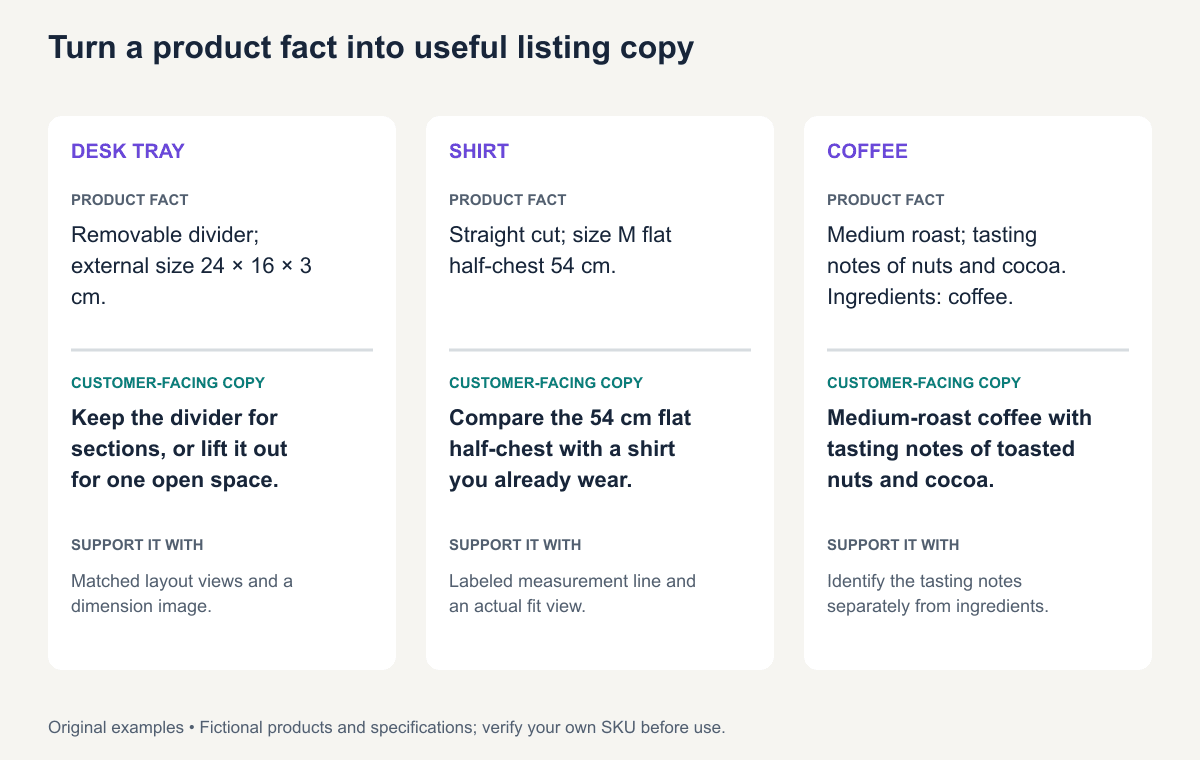
Choose the pattern that answers your product's main uncertainty, then replace every teaching fact with your verified SKU data. The supporting image should make the same distinction visible: a dimension view, a labeled fit view, or an ingredient-and-preparation explanation.
Which description pattern fits your product?
Choose a lead structure around the uncertainty that remains after seeing a photograph:
| Unresolved question | Lead with | Follow with |
|---|---|---|
| Will it fit me or my space? | Fit, dimensions, compatibility | How measurements were taken and use conditions |
| What is it like to use? | A concrete use scenario | Steps, limitations, and specifications |
| What does it taste or feel like? | Carefully chosen sensory language | Composition, preparation, and source of the description |
| Why this version? | A clear variant comparison | Exact attributes and tradeoffs |
| What is included? | An explicit contents list | A labeled photograph and separately sold items |
Several patterns can share a page. Put the most consequential decision first; do not force every item into a story-led opening.
A before-and-after product description example
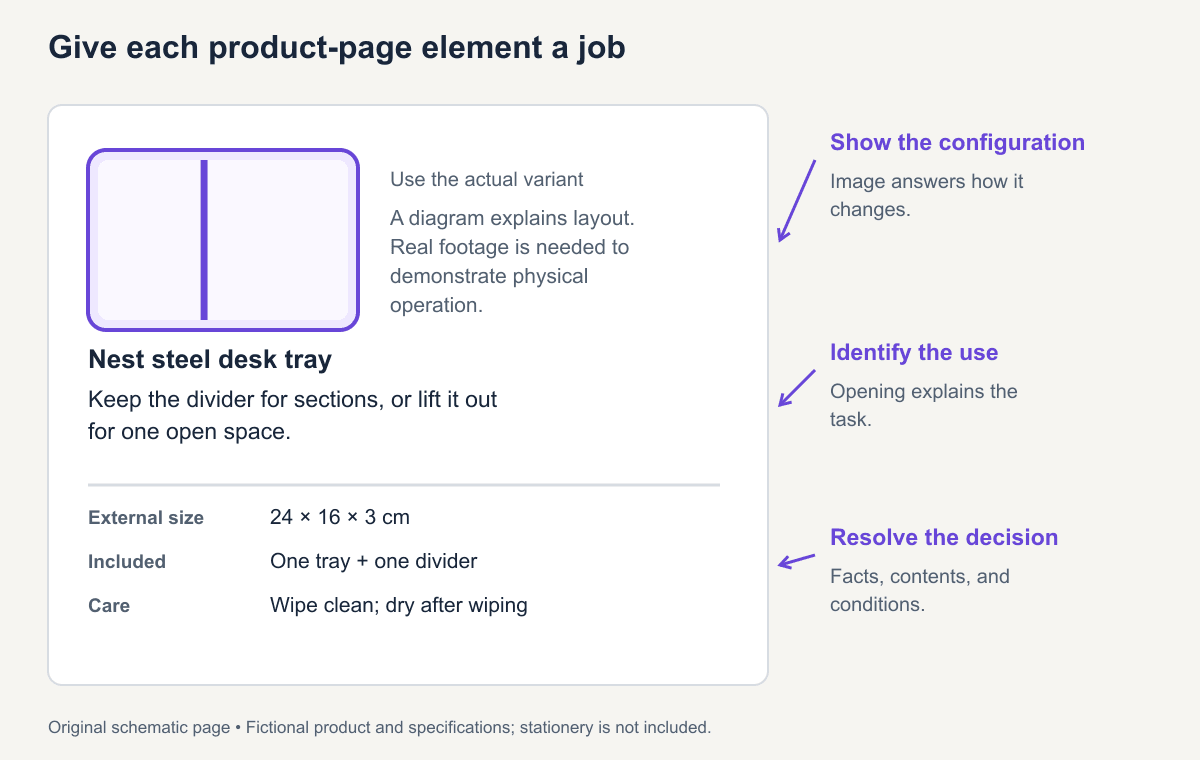
Suppose a fictional desk tray is made from powder-coated steel, measures 24 × 16 × 3 cm, contains one removable divider, and should be wiped clean. It has not been tested for scratch resistance. These are invented teaching inputs.
Before: “Meet your ultimate desk upgrade. This premium organizer transforms any workspace with stylish, durable storage.”
After: “Keep pens and small desk items in a 24 × 16 cm steel tray. Leave the removable divider in place for two sections, or lift it out for one open compartment. The tray is 3 cm high, has a powder-coated finish, and should be wiped clean. Includes one tray and one divider; stationery is not included.”
The rewrite identifies the object, explains an actual configuration choice, states dimensions, and prevents an inclusion mistake. It makes no unsupported scratch-proof claim and reports no conversion result.
For the accompanying image, show both divider configurations at the same scale. Add a caption stating that the stationery demonstrates use. That gives the copy and image different, complementary jobs.
A product description template to adapt
Use the following sequence as a starting point:
- Identify the product and its main use in one clear sentence.
- Explain the feature that matters most to that use.
- Add a scannable list of decision-critical specifications.
- State compatibility, care, exclusions, and included items.
- Offer the next relevant action, such as selecting a size or inspecting a configuration.
Download the description-pattern audit sheet to map buyer questions to copy and media. For a complete start-to-finish process, continue to how to write product descriptions.
Adapt the structure to your own catalog
Borrow the way information resolves a question. Write original copy using your own specifications, images, and customer situations. Brand reviews, certifications, test percentages, prices, and service terms require separate verification before they appear on your page.
Check the selected variant again when publishing. A useful article should help you choose a structure; it should never become a source of someone else’s product facts for your catalog.
Your revised listing can also brief a product video. Explore ReelFlock’s product-video workflow with one buying question from your description and the product details needed to answer it.
Frequently asked questions
What should a good product description include?
Identity, intended use, meaningful features, decision-critical specifications, and conditions or exclusions. Add evidence where the shopper cannot judge an important property from the main image.
Are short or long product descriptions better?
Use enough information to resolve the buying questions. Put a short orientation at the top and make details easy to scan. Word count alone does not show whether the description is complete.
Can I use the same structure across different products?
Yes, for stable fields such as dimensions, composition, care, and included items. Let the lead explanation and proof assets vary with the product’s main uncertainty.