
What an advertisement for a product needs
To create an advertisement for any product, choose a specific buyer and situation, identify one useful product fact, and build a message that shows why that fact matters. Include a recognizable product, supporting evidence or a clear explanation, and an appropriate next step.
Start with one SKU you sell and one question a shopper needs answered. You will leave with a headline, short copy, a visual plan, and a destination, plus a way to adapt the same idea for a static ad and a short video.
Google’s YouTube ABCD playbook likewise treats attention, branding, connection, and direction as distinct creative jobs. Our examples below apply a similar discipline to a seller’s first product-ad brief: make the product clear, explain a relevant use, and provide a next step.
Use this five-part structure:
| Part | Question | Example for a fictional removable-divider tray |
|---|---|---|
| Product | What is being advertised? | A steel desk tray |
| Buyer | Who has the relevant task? | Someone organizing a small desk |
| Main message | What useful difference matters? | The divider changes the interior layout |
| Support | What makes the message believable? | A real demonstration or clearly labeled illustration |
| Next step | What can the person do now? | Inspect both configurations |
Step 1: Pick the product and the person you want to reach
Choose an item with accurate product facts, usable images or a sample, and a working product page. If you have several candidates, begin with a SKU whose important buying question you can demonstrate. Keep current stock, variant availability, and delivery terms in the brief so the creative team works from a usable offer.
Narrow the person by situation. “Everyone who likes fashion” gives little direction. “A commuter choosing a light overshirt to wear over a tee” suggests the fit information and pictures that might matter. A clear scenario helps you choose; it does not prove that everyone in that scenario wants the product.
Write down the alternative too. The person may already own another item, use a workaround, or choose not to buy. Your ad should explain a relevant difference without inventing a competitor’s weakness.
Step 2: Choose one selling point you can demonstrate
List the product’s verified facts. Then connect one fact to the buyer’s task. Use features, advantages, and benefits if the connection is unclear.
For the fictional tray, a removable divider supports “two interior configurations.” It does not establish “double your productivity.” The first can be illustrated or demonstrated; the second requires a very different kind of evidence.
Prefer an honest visual test to an exaggerated adjective. If your ad says a bag fits a laptop, identify the exact bag and device dimensions, then show the fit under normal use. If you only have a concept drawing, label it as a concept and avoid implying a physical test occurred.
To develop a broader reason to choose the product, use the USP examples. For this first ad, keep one message in focus.
Step 3: Write the headline, message, and CTA
The headline should give the right person a reason to continue. It can state a useful fact, pose a relevant question, or describe a recognizable task. It does not need to be a pun.
The body should explain the fact and its conditions. The CTA should name a next action that is actually available. “See the two layouts” is appropriate for a demonstration page; “Buy now” requires a real purchasable offer.
For your store, link the action to the featured SKU or relevant comparison. Keep the product, bundle, price, and terms consistent from the ad to the page. Use real evidence for testimonials, approvals, and product results, and use a deadline only when the offer actually has one.
3 complete product advertisement examples
These are original teaching ads for fictional products. All names, specifications, and product circumstances are invented for the exercise. They are not tested campaigns.
1. A beverage advertisement
Teaching facts: Sol Orchard is a 250 ml sparkling apple drink in a can. Serve chilled. No verified claims about sugar, ingredients beyond the product identity, or health benefits are supplied.
Audience: Someone choosing a chilled drink for a picnic.
Headline: “Sparkling apple drink for your picnic.”
Body: “Sol Orchard is a sparkling apple drink in a 250 ml can. Chill it before packing, then pour or drink from the can when you are ready.”
Visual: An original illustration or an accurate photograph of the can beside a picnic glass. Show only the actual product and clearly distinguish serving props.
CTA: “View the drink details.”
15-second video concept: Open on a picnic setup, identify the can, show the serving size and a pour, then end with the product name and details action. Use a genuine recording for a real pour; an animated pour is an illustration of the concept.
Why it works as a first draft: The product is identifiable and the context is concrete. The copy does not infer “natural,” “low sugar,” or “healthy” from the apple imagery. A real launch would require a verified ingredient and nutrition record before adding those claims.
2. A clothing advertisement
Teaching facts: Field is an olive, unlined overshirt in 100% cotton twill, with a relaxed cut, button front, and two chest pockets. No weather-protection test is supplied.
Audience: Someone looking for a layer to wear over a tee.
Headline: “An overshirt to wear open or buttoned.”
Body: “Layer the Field overshirt over a tee, then wear it open or buttoned. Made from cotton twill with an unlined construction and a relaxed cut. Compare the garment measurements for the fit you prefer.”
Visual: The same garment worn open and closed, shown at the same scale. Add a close-up of the twill and a clear color label. Include the worn size and model reference only if verified.
CTA: “Compare the garment measurements.”
15-second video concept: Show open styling, fasten the front, cut to the two chest pockets, and finish with a readable prompt to check sizing. Do not imply waterproofing with rain footage.
Why it works as a first draft: The ad focuses on a use and shows the relevant construction. The destination supports the unresolved decision: fit. It does not promise a universal fit or a specific temperature rating.
3. An everyday household product advertisement
Teaching facts: Nest is a powder-coated steel desk tray, external size 24 × 16 × 3 cm, with one removable divider. The package includes one tray and one divider.
Audience: Someone organizing pens and small items on a desk.
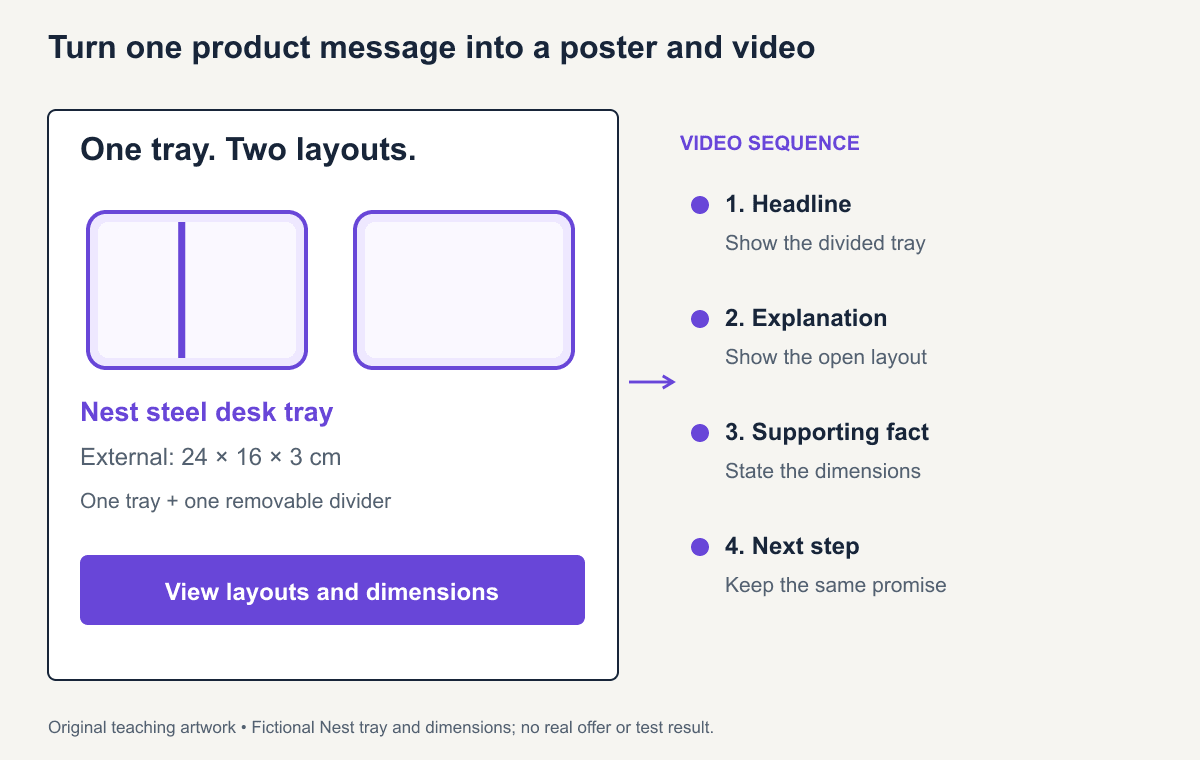
Headline: “One tray. Two layouts.”
Body: “Keep the divider in place for two sections, or lift it out for one open space. Nest measures 24 × 16 × 3 cm externally. Includes one steel tray and one removable divider; stationery is not included.”
Visual: Two top-down configuration views at matching scale, plus a labeled dimension diagram. A real product ad should show the actual item; our teaching art is schematic.
CTA: “See both layouts and dimensions.”
15-second video concept: Show the divided tray, show the divider removed, state the footprint, and close with the configuration action.
Why it works as a first draft: The headline’s promise is answered directly by the visual. The body resolves size and inclusion questions without inventing a productivity or durability benefit.
Turn one advertisement into a poster and a short video
The message can stay the same while its delivery changes. A poster needs an understandable hierarchy in one view. A video needs a sequence where the important information survives time and movement.
For the tray poster, place the headline above the two configuration diagrams. Put the dimensions and inclusion line close to the product. Use one action at the bottom. The illustration in this article is an original teaching layout, not a screenshot of a brand campaign.
For the short video, use this sequence:
| Target time | Picture | Text | Purpose |
|---|---|---|---|
| 0–3 seconds | Divided tray | One tray. Two layouts. | Establish the message |
| 3–7 seconds | Open tray with divider shown separately | One removable divider | Explain the difference |
| 7–11 seconds | Dimension graphic | External: 24 × 16 × 3 cm | Support a fit decision |
| 11–15 seconds | Both layouts and product name | See layouts and dimensions | Offer a relevant next step |
The commercial video tutorial includes a finished motion-graphic version of this teaching concept. It is a visual explanation, with no physical product-performance claim.
To take your own product-ad idea into video, explore ReelFlock’s product-video workflow. Begin with the real SKU and carry the same message and destination from your ad brief into production.
Adapt the idea to the shopper's next decision
For the fictional tray, the core product stays the same while the emphasis changes:
| Shopper question | Headline direction | Visual priority | Destination |
|---|---|---|---|
| What does it do? | One tray. Two layouts. | Divider removal and both configurations | Product explanation |
| Will it fit? | Check the footprint beside your keyboard | Accurate dimensions and scale reference | Dimension guide on the product page |
| Which package am I ordering? | One tray and one removable divider | Actual package contents, props labeled | Exact SKU and contents |
Choose one version first. A new shopper needs enough context to recognize the product; someone comparing dimensions needs the measurement quickly. Keep your offer honest and visible, and let the image do part of the explanation.
For a complete first deliverable, save the headline, body, chosen image or shot list, exact destination, and claim sources together. Hand the same brief to the designer or editor so a layout change does not accidentally change the product promise.
A product advertisement template you can fill in
Write the brief first, then the visible ad:
Exact product and variant:
Buyer and situation:
Current alternative:
One important product fact and its source:
Why that fact matters in this situation:
Visual that demonstrates or explains it:
Conditions, exclusions, or limits:
Headline:
Body copy:
CTA and actual destination:
Poster hierarchy or video beat order:
Review owner and date:
Download the product-ad brief worksheet. Use one row per claim so the evidence does not disappear when the headline changes.
Review your advertisement before using it
Show the draft without explaining it. Ask what is being sold, who might use it, what the main message is, and what happens next. If the answers differ from your intention, fix the specific ambiguity.
Check that the picture supports the words. A stainless-steel-looking render should not advertise a plastic item. A styling prop should not appear to be included. A large numerical claim needs its conditions and supporting source.
Finally, open the destination and compare the product, variant, terms, and next step. Use the nine-element advertisement review to prioritize improvements. A clear first draft is ready for review; performance still needs evaluation in the real placement.
Frequently asked questions
Which product should I advertise first?
Choose a SKU with a clear buying reason, accurate facts, usable assets, and a working destination. Check availability and the economics of the offer before spending. Begin with one buyer question you can answer convincingly.
Can I create an advertisement for a fictional product?
Yes, for practice or concept development. Label the product and specifications as fictional. Do not present made-up testimonials, certifications, test data, or campaign outcomes as real.
What is the difference between a product ad and a brand ad?
A product ad emphasizes a particular item and a relevant buying reason. A brand ad builds recognition or meaning for the broader business. Both benefit from a clear audience, a supported message, and a suitable next step.