
What makes shoppers choose your product?
A shopper has your product page open alongside two similar listings. All three promise quality, show attractive photos, and offer a discount. What gives that shopper a reason to buy from your store?
A unique selling proposition (USP) states a meaningful reason to choose your product over the alternatives that shopper is considering. For an ecommerce seller, that reason might be a fit option, a storage-saving design, a preparation method, or a service that resolves a purchase concern. The product page and ad need to make the difference clear and provide evidence for it.
Start with one SKU and one buying situation. “Premium home essentials” leaves the shopper to work out the benefit. “A laundry carrier that folds to a 4 cm profile for narrow cupboards” explains a specific use. The measurement in this example is fictional; a real listing needs the actual product specification and a matching image.
Three related messages have different jobs in your store:
| Message | What it tells the shopper | Fictional example for a repairable backpack |
|---|---|---|
| Value proposition | The overall value of the offer | Carry your work essentials with organized storage and repair support. |
| USP | A specific reason to choose this product | Replace the worn base panel while keeping the rest of the bag. |
| Slogan | A memorable expression of the brand | Keep carrying. |
Build your USP from the buying problem first. Then translate it into the product-page opening, a useful product image, and a video demonstration. A slogan can come later.
8 unique selling proposition examples ecommerce sellers can use
These are our interpretations of the brands’ positioning. Product and service facts were checked against the linked official pages on October 29, 2026. Suggested listing lines and video hooks are original teaching examples for a seller adapting the approach; they are not quotations or measured results from the brands. Use a suggested claim only when your own product supports it.
| Example | Buying question | Sellers who can apply the approach |
|---|---|---|
| Pip’s Heirloom Snacks | What makes these ingredients worth choosing? | Food and ingredient-led products |
| Kloo | How does this fit into my daily routine? | Drinks, concentrates, and preparation products |
| ThirdLove | Can I find a size that works for me? | Apparel and other fit-sensitive goods |
| Bee’s Wrap | How would I use this alternative? | Reusable kitchen and household products |
| Hiut Denim | What does this maker know about the product? | Specialist apparel, craft, and premium goods |
| Bellroy | Will this solve an everyday carrying problem? | Wallets, bags, and compact accessories |
| Warby Parker | How can I choose confidently online? | Eyewear and products with selection uncertainty |
| FedEx | Can I rely on the delivery promise? | Stores whose customers buy for a deadline |
1. Pip’s Heirloom Snacks: make the ingredient matter to the shopper
Pip’s makes heirloom corn central to its product story. Its official FAQ explains the corn behind its snacks. This gives a snack shopper a specific attribute to investigate beyond a broad quality claim.
For a food seller, the useful question is what the ingredient changes in the product experience. Lead with an ingredient only when you can explain why a buyer would care. Keep nutrition and health claims within the evidence for the exact product.
Apply it to your listing: Put the ingredient difference near the opening, then show the ingredient and finished product together. A teaching line for a relevant product is: “Made with heirloom corn—see the kernels behind your next snack.” Follow with the product’s verified ingredient and preparation details.
Turn it into an ad: Open with a close-up of the ingredient beside the finished snack. A possible hook is “What goes into this bag?” Use the next shot to answer it. A scale reference makes an ingredient-size comparison easier to judge; an attractive close-up alone cannot prove a health benefit.
2. Kloo: sell a preparation routine shoppers can understand
Kloo’s coffee concentrate page explains a concentrated format and how to prepare it. The shopper can evaluate the preparation routine alongside the product itself.
This approach suits sellers of concentrates, drink mixes, and products that replace several preparation steps. Write down the actual sequence, including dilution, equipment, and storage. Decide which part of that sequence matters to your buyer.
Apply it to your listing: A teaching opening is “Coffee concentrate to mix by the cup.” Place the verified mixing ratio, serving information, and storage instructions within easy reach. These details let a shopper judge whether the product fits their mornings.
Turn it into an ad: Show the complete preparation from concentrate to finished drink. “Here’s how this coffee concentrate becomes your morning cup” introduces a demonstration you can deliver on screen. If speed is the selling point, measure the complete process before adding a time claim.
3. ThirdLove: address the reason a shopper hesitates over sizing
ThirdLove’s sizing guidance includes half-cup sizing. The offer addresses a recognizable purchase problem: the size options a shopper has tried may leave them between choices.
For apparel sellers, look for the fit question your assortment can actually answer. That might concern length, width, proportions, or adjustable construction. State the available option and make selection instructions easy to find.
Apply it to your listing: For a fictional trouser range with two verified inseams, a useful opening is “Choose the inseam for your height and preferred break.” Show measurements for each variant, how to measure, and the model’s relevant sizing details. This gives the shopper a concrete selection task.
Turn it into an ad: A hook such as “Waist fits, but the legs are too long?” can lead into a demonstration of the available lengths. Label each variant and keep the comparison conditions consistent. Include the size guide as the next step, and avoid suggesting that one option fits every body.
4. Bee’s Wrap: show how an unfamiliar format handles a familiar job
Bee’s Wrap’s sandwich wrap combines a reusable wrap format with a fastening detail. A shopper can picture packing a sandwich and closing the wrap.
For household-product sellers, make the change in routine visible. Buyers considering a reusable alternative need to understand setup, use, cleaning, and storage. Those details belong in the purchase decision.
Apply it to your listing: A teaching line for a matching product is “Wrap your sandwich, fasten it, and reuse the wrap after care.” Support it with an image sequence and exact care instructions. Confirm the materials for the selected variant; a beeswax product and a vegan version need their own copy.
Turn it into an ad: Film wrapping, fastening, and the appropriate care sequence. “How does this wrap stay closed?” is an opening question the demonstration can answer. Keep any claim about waste or environmental savings separate until you have evidence for the comparison and repeated-use assumptions.
5. Hiut Denim: connect specialist expertise to product details
Hiut is associated with denim expertise and craft. For an ecommerce seller, the useful lesson is to show what specialist attention changes about the product a customer receives.
Keep historical shorthand current. Hiut’s Do One Thing Well collection also lists accessories and other products, so a present-day description that says the company sells only jeans would be inaccurate.
Apply it to your listing: Choose one detail you can explain: a seam, fabric choice, repairable component, or construction method. A teaching heading such as “Why we chose this seam” should lead into close-up images and an explanation of its purpose. A maker’s biography can support that explanation, but shoppers still need product details.
Turn it into an ad: Start with “Look inside this seam,” then show the construction and explain the design decision. Use the maker or product specialist to narrate what is visible. Claims about lifespan or durability need evidence beyond the appearance of careful workmanship.
6. Bellroy: make a physical difference easy to judge online
Bellroy’s Slim Sleeve product page positions the wallet around a slim format and minimalist carrying. That connects the product to a recognizable daily preference.
For accessory sellers, a physical attribute can provide a strong buying reason when the shopper can judge it. Dimensions, a useful scale reference, and a demonstration with realistic contents help translate a specification into a purchase decision.
Apply it to your listing: A teaching opening for a matching wallet is “A slim wallet for the cards you carry every day.” Follow with the actual dimensions and supported capacity. Show the loaded profile as well as the empty product.
Turn it into an ad: Try “Here’s the wallet with my everyday cards inside,” followed by the loading sequence and side view. For a comparison, use the same contents in both wallets and identify the models. This is a suggested demonstration method; we have not conducted a comparative bulk test of Bellroy’s product.
7. Warby Parker: remove uncertainty before asking for the purchase
Warby Parker’s mailed Home Try-On is a familiar historical example of reducing uncertainty when buying glasses online. Its current Home Try-On page says that program has ended and directs shoppers toward other selection options, including virtual tools.
The ecommerce lesson remains useful: identify what the shopper cannot confidently decide from the listing. It might be frame appearance, component compatibility, garment sizing, or setup requirements. Then offer a current way to answer that question.
Apply it to your listing: For a fictional accessory store, “Check your device model before choosing a case” can lead to a clear compatibility table. For a clothing store, place the size guide close to variant selection. The reassurance must connect to a usable tool or accurate information.
Turn it into an ad: Demonstrate the actual selection step. “Check these two details before ordering your case” can show the model number and matching variant. Send viewers to the same guide from the product page. Recheck the message when models, tools, or policies change.
8. FedEx: turn a delivery promise into a usable buying decision
FedEx’s historical overnight positioning addressed a consequential deadline. The company’s history of its advertising dates the well-known overnight campaign to 1978–1983. That historical example does not establish a current shipping guarantee.
For ecommerce sellers, the application is the store’s delivery offer. A gift buyer, event shopper, or customer replacing a needed item may compare arrival options alongside the product. Your fulfillment operation must support the promise.
Apply it to your listing: A fictional, conditional example is “Order by noon for next-business-day delivery to eligible postcodes.” Use it only if your actual service supports every part of the statement. Put the postcode check, cutoff timezone, exclusions, and relevant terms close to the promise.
Turn it into an ad: “Need it for Friday? Check delivery to your postcode” gives deadline-driven shoppers a concrete next action. Show the current delivery checker. A packing video can illustrate your process, but arrival claims need fulfillment evidence and current service terms.
Choose a USP for the product you sell
Start with the purchase concern your store can resolve. Use questions from your own product inquiries, reviews, and return reasons to identify candidates; do not invent customer feedback to justify a preferred message.
| What a shopper needs to decide | Possible USP direction | What to put on the product page |
|---|---|---|
| Will it fit me or my device? | A specific fit option or compatibility service | Measurements, variant selector, compatibility guide |
| Will it fit my space? | A compact, folding, or adjustable design | Dimensions, scale image, setup demonstration |
| Will I use it regularly? | A preparation or care routine that suits them | Complete use sequence and instructions |
| Why pay more for this version? | A relevant material, construction, or service difference | Detail photographs, specifications, current service terms |
| Will it arrive in time? | A delivery option your operation can honor | Destination check, cutoff, estimated arrival and conditions |
Compare the exact alternatives the shopper might buy: the same product category, relevant variant, and delivery market. Record what each listing promises and what you can verify. A feature shared by every option may still answer an important question, but it gives you little basis for claiming exclusivity.
Choose one main buying reason for a particular listing or ad. Keep supporting features in the details. This makes the opening understandable and gives your demonstration a clear job.
Choose among competing selling points
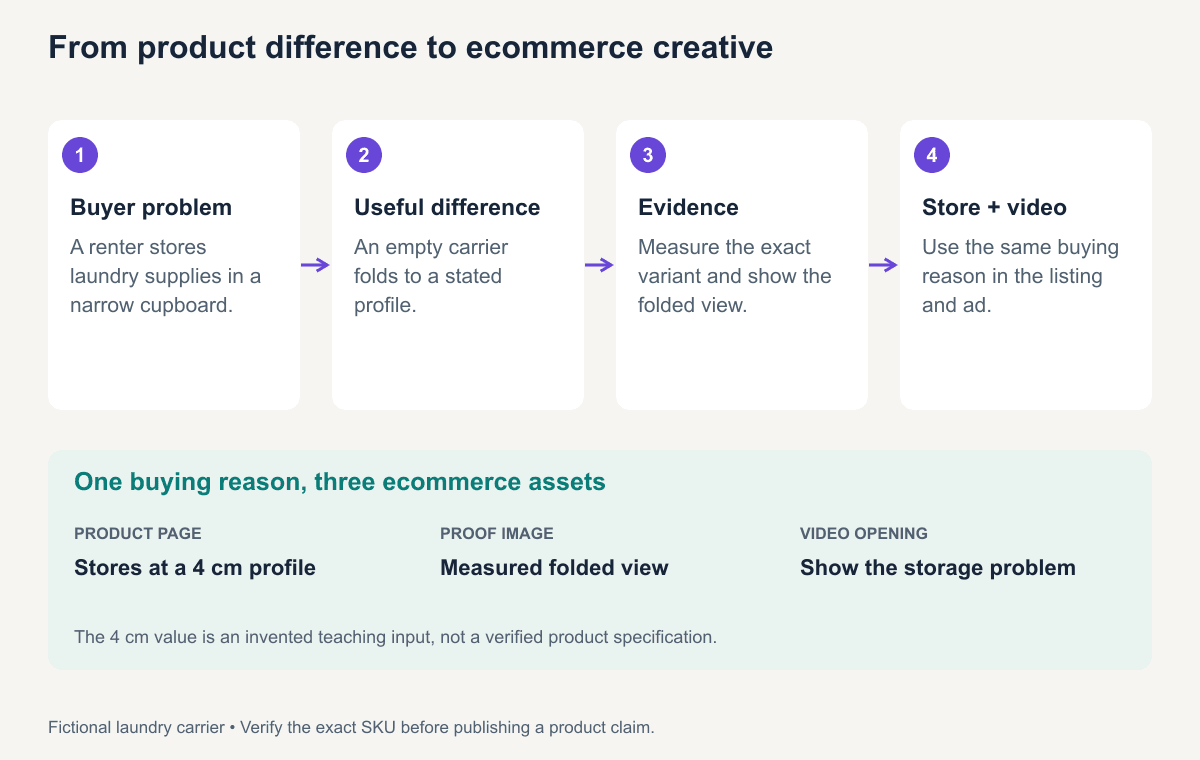
Suppose you sell the fictional folding laundry carrier. Three candidate messages are “available in several colors,” “folds to a 4 cm profile,” and “a low introductory price.” For the shopper storing it in a narrow cupboard, folded size directly answers the purchase problem. Color can remain a selection option, and the temporary price belongs in the current offer.
Use three checks before choosing your opening: does the difference matter to this buyer, can you demonstrate it for this SKU, and does it help compare realistic alternatives? If the folded profile is common across the shortlist, explain it accurately and look for another supported distinction in the offer. The worksheet's job is to help make that choice, not produce a slogan for every feature.
Build your USP from product facts
Use this worksheet sentence to organize the message:
For [shopper in a specific situation], [product] offers [relevant difference], supported by [specification, demonstration, or service evidence].
Consider a fictional seller of a folding laundry carrier. The shopper rents an apartment with a narrow cupboard and currently uses a rigid basket. The invented product fact is a 4 cm folded depth when empty.
| Step | Seller’s working note |
|---|---|
| Buyer situation | Needs to store the empty carrier in a narrow cupboard |
| Relevant alternative | A rigid basket that occupies its full footprint when empty |
| Product difference | Folds to a 4 cm profile when empty; fictional specification |
| Evidence needed | Measured side view of the exact SKU, open dimensions, full folding sequence |
| Draft USP | A laundry carrier that folds to a 4 cm profile for storage in narrow spaces |
| Limits to explain | Empty folded size, open dimensions, stated capacity, folding instructions |
“Premium laundry basket for modern living” gives the shopper little to compare. The draft USP gives them a storage dimension to check against their cupboard. Before publishing it, the seller would need to verify the measurement and ensure the demonstration matches the listed variant.
Download the ecommerce USP worksheet to record the SKU, buying problem, alternative, product-page opening, video hook, and proof shot. It also includes fields for the evidence owner and review trigger, so a product or policy change can be reflected in the listing.
Turn one USP into a product page and a 15-second ad
Keep the same buying reason across the ad and its destination. In the fictional carrier example, a storage-focused video should lead to a listing that makes the folded size easy to find.
Product-page opening: “A folding laundry carrier that stores at a 4 cm profile when empty.”
First supporting image: Show the folded carrier beside a ruler, followed by the open product with its dimensions. State the exact SKU and measurement conditions.
Supporting details: Include capacity, materials, carrying instructions, and care. These answer the remaining purchase questions without crowding the opening.
Use this original 15-second storyboard as a starting point. The duration is an editorial example, not a tested performance recommendation.
| Time | Picture | Spoken or on-screen message | Purpose |
|---|---|---|---|
| 0–3 seconds | Show the storage space and the carrier beside it | “Need to store your laundry carrier in a narrow space?” | Identify the buying problem |
| 3–7 seconds | Show the empty carrier folding | “This one folds down when empty.” | Demonstrate the mechanism |
| 7–11 seconds | Show a ruler beside the folded carrier | “Folded depth: 4 cm.” | Make the fictional specification measurable |
| 11–15 seconds | Show the open carrier and its dimensions | “Check the dimensions for your space.” | Direct the shopper to the product details |
Shoot the real product for any footage intended to prove size or operation. A graphic can explain a folding mechanism; it cannot establish the measured performance of a physical SKU. If you use AI-generated creative, review it against the actual product and keep factual demonstrations grounded in verified assets.
For the next step, use the product description workflow to build the full listing or the marketing video script guide to expand the storyboard into a production brief.
Once you have a supported buying reason, develop it into a product-video script with ReelFlock. Use that USP as the main message and keep your proof shot in the brief.
Check whether your USP helps shoppers decide
Before changing a live listing, show the proposed opening and image to prospective buyers. Ask what the product is, who it suits, why they might choose it, and what they still need to know. Record their answers before explaining your intention. These conversations can uncover confusion; a few responses do not establish market-wide demand.
For a live comparison, test one message change against a defined purchase outcome while keeping the offer and traffic conditions comparable. Check that the destination repeats the buying reason and supplies the promised evidence. If an ad attracts clicks but few suitable buyers, review what the opening led them to expect.
Record the changed copy, SKU, source, and date in the worksheet. Use the CTA test example for denominators and downstream outcomes. The immediate deliverable is one supported buying reason, one product-page opening, and the evidence needed to make it credible.
Frequently asked questions
Can a small online store have a USP?
Yes. A relevant distinction may come from a fit option, a carefully defined bundle, helpful compatibility information, repair support, or a delivery service. Choose something your store can consistently provide and explain what the shopper receives.
What if I sell the same product as other stores?
Compare the complete offer: product, selection help, bundle contents, fulfillment, and support. A useful distinction can sit in those surrounding services when your operation actually provides it. If the offers are equivalent, improve a part that matters to shoppers before claiming differentiation.
Is a discount a USP?
A temporary discount is a purchase incentive that needs clear dates and terms. It may be easy for another seller to match. For a lasting price-based position, specify the basis of comparison and check that your costs and service can sustain the offer.
Can different products in my store have different USPs?
Yes. State each SKU’s buying reason while keeping the store’s broader promise consistent. A travel bag may lead with storage dimensions; another may lead with capacity. Explain the tradeoffs and connect each ad to the matching product page.
How do I know whether my USP is actually unique?
Maintain a dated comparison against the products your customers consider. Match variants, markets, and service conditions. Use precise descriptions of your offer when exclusivity is unproven, and reserve claims such as “only” for differences you can substantiate.