
A creative brief tells the production team who the video is for, what it should communicate, which evidence supports that message, and what must be delivered. A useful ecommerce brief also identifies the exact product and offer so a persuasive video does not drift away from the item a shopper can actually buy.
Use the copyable template below for an internal team, a paid creator or an AI-assisted production workflow. It includes a filled example and a method for turning the brief into distinct video requests.
Copy this ecommerce creative brief template
The template is available in full here; no signup is required. Copy it into your working document and remove fields that have no bearing on the assignment.
PROJECT
Campaign / brief ID:
Version and last updated:
Business owner / production contact / final approver:
Launch window:

BUSINESS TASK
What needs to change for the business:
Primary viewer action:
How we will evaluate the content:
Reporting window and comparison limitations:

BUYER AND SITUATION
Intended buyer:
Situation that makes the product relevant:
Main question or objection:
What the buyer should understand after watching:

PRODUCT AND MESSAGE
Product ID / exact variant / pack quantity:
Destination or listing reference:
One main message:
Verified facts the script may use:
Evidence and asset reference for each material claim:
Statements or implications to avoid:

CREATIVE DIRECTION
Opening idea or question:
Required demonstration or explanation:
Tone, with a concrete wording example:
Reference creative and the specific element to learn from:
CTA wording and actual destination:

DELIVERABLES
Placement and aspect ratio:
Number of distinct concepts:
Variations required within each concept:
Target duration and destination-specific specifications:
Final files, editable files and clean versions required:
Description, subtitles and cover requirements:

OFFER AND RIGHTS
Price / promotion / valid dates, if included:
Stock and delivery information owner:
Music, footage, likeness and creator usage permissions:
Paid media, editing, territories and usage term agreed:
Required commercial or AI-content disclosures:

REVIEW AND DELIVERY
Assets due / sample due / feedback due / final due:
Production budget and what it includes:
Included revision rounds and change-request process:
Named approver and approval record location:
Acceptance checks:
Dependencies that can block release:
The general structure of a creative brief usually covers audience, objective, message, deliverables and schedule. The product, evidence and acceptance fields make this version practical for a seller handing off video production. Smartsheet: Creative brief elements and examples.
Fill the difficult fields before writing the opening
Start with the product, buying question and evidence. They determine what a truthful video can show. Writing a dramatic hook first can create a promise the team spends the rest of the project trying to justify.
Be specific about the viewer's situation. “Adults interested in home products” gives production little direction. “People checking whether an organizer will fit a narrow bathroom counter” points toward dimensions, footprint and an actual placement demonstration.
Choose one main message. Supporting details can help explain it, but five competing promises make the brief hard to approve and the short video hard to follow.
Write the intended action in terms the viewer can carry out: inspect the dimensions, choose the correct size, open the relevant listing or compare available finishes. “Drive engagement” does not tell the writer how to end the video.
A filled creative brief for a product-video batch
This is a fictional teaching example. The product facts, budget and schedule are invented to demonstrate a complete assignment; they describe no real ReelFlock customer or campaign result.
Project: Narrow Counter Organizer / brief NCO-01 / revision 1.
Owner and approval: Store merchandising lead owns the facts; content producer manages delivery; merchandising lead gives final approval.
Launch: Release after stock and listing checks pass. Working schedule begins when approved assets are supplied.
Business task: Help shoppers determine whether the organizer suits a narrow counter. Evaluate available product clicks and related buyer questions over the first two weeks, noting stock and offer changes. No performance target is promised by the brief.
Buyer and situation: A person arranging a small bathroom counter who needs to judge footprint and capacity before purchasing. Their main objection is “Will this take up too much space?”
Product: Organizer NCO-A, white, one unit, assumed verified footprint 24 × 12 cm. The source listing and actual product are the references. No claim about holding every bottle size.
Main message: Check the organizer's footprint and see a realistic arrangement before choosing.
| Fact or message | Required support | Script treatment |
|---|---|---|
| 24 × 12 cm footprint | Product specification and a measurement shot | Show both dimensions with units |
| Example arrangement | Real footage of the exact items | Identify it as one arrangement |
| White finish | Accurate product imagery | Maintain the same finish throughout |
| Current availability | Listing check before release | Leave stock urgency out of the evergreen video |
Creative direction: Calm and practical. Example line: “Measure the clear space beside your sink, then compare it with this footprint.” Avoid “the ultimate storage solution.” Open on the counter and the measurement; keep decorative objects away from the critical view.
Deliverables: Two concepts, each with two different openings: four final 9:16 videos, targeting about 20 seconds each. Concept A explains footprint. Concept B shows the arrangement. Supply final exports, a clean version without temporary sales text, checked descriptions and subtitle text. Confirm final upload specifications against the selected destination.
CTA: “Check dimensions and available finishes on the product page.” The listing must show NCO-A and the same measurement units.
Rights and offer: Use seller-owned product assets and commercially cleared audio. No customer testimonial, health claim, limited-stock message or delivery deadline. Any creator agreement must specify the intended organic and paid uses, editing rights and term before production.
Working schedule: Day 1: approved facts and assets. Day 3: one sample for each concept. Day 4: consolidated feedback. Day 6: four revised outputs. Day 7: final approval and listing recheck. These are example working days, not a service promise.
Budget: Fictional production allowance of $600, excluding media spend. Includes the four outputs and one consolidated revision round. A new product or new concept requires an agreed scope change.
Acceptance: Correct variant and dimensions; readable measurement; real arrangement shown accurately; no unsupported capacity claim; clear CTA; four distinct outputs; rights and final approval recorded. Missing specifications or usage permission block release.
Turn vague requests into usable direction
| Vague request | More useful direction |
|---|---|
| Make it authentic | Use a practical counter setup and conversational wording; preserve an honest view of the product |
| Make it premium | Show the finish clearly, use controlled lighting and avoid cluttered graphics |
| Show that it saves space | Show its measured footprint and one realistic arrangement |
| Make several versions | Produce two openings for each of the two named concepts |
| Add a strong CTA | Ask the viewer to compare dimensions on the correct listing |
Concrete direction leaves room for creative judgment while removing guesswork about the promise. References work the same way: name the specific element you want to learn from, such as the overhead reveal or order of explanation. A reference video's visible success does not establish that its claims, assets or performance will transfer to your product.
Keep the brief, script and storyboard connected
The brief defines the assignment. The script writes the spoken and on-screen message. The storyboard sequences the visible action. Link them through the same product identifier, message and version so reviewers can trace a change.
In the organizer example, the brief requires a measurement. The script names the units. The storyboard shows the ruler and the footprint. If the product dimensions change, all three need inspection before the next release.
Avoid filling the brief with every camera angle. Add enough direction to protect the evidence and leave detailed production choices to the script and storyboard stages.
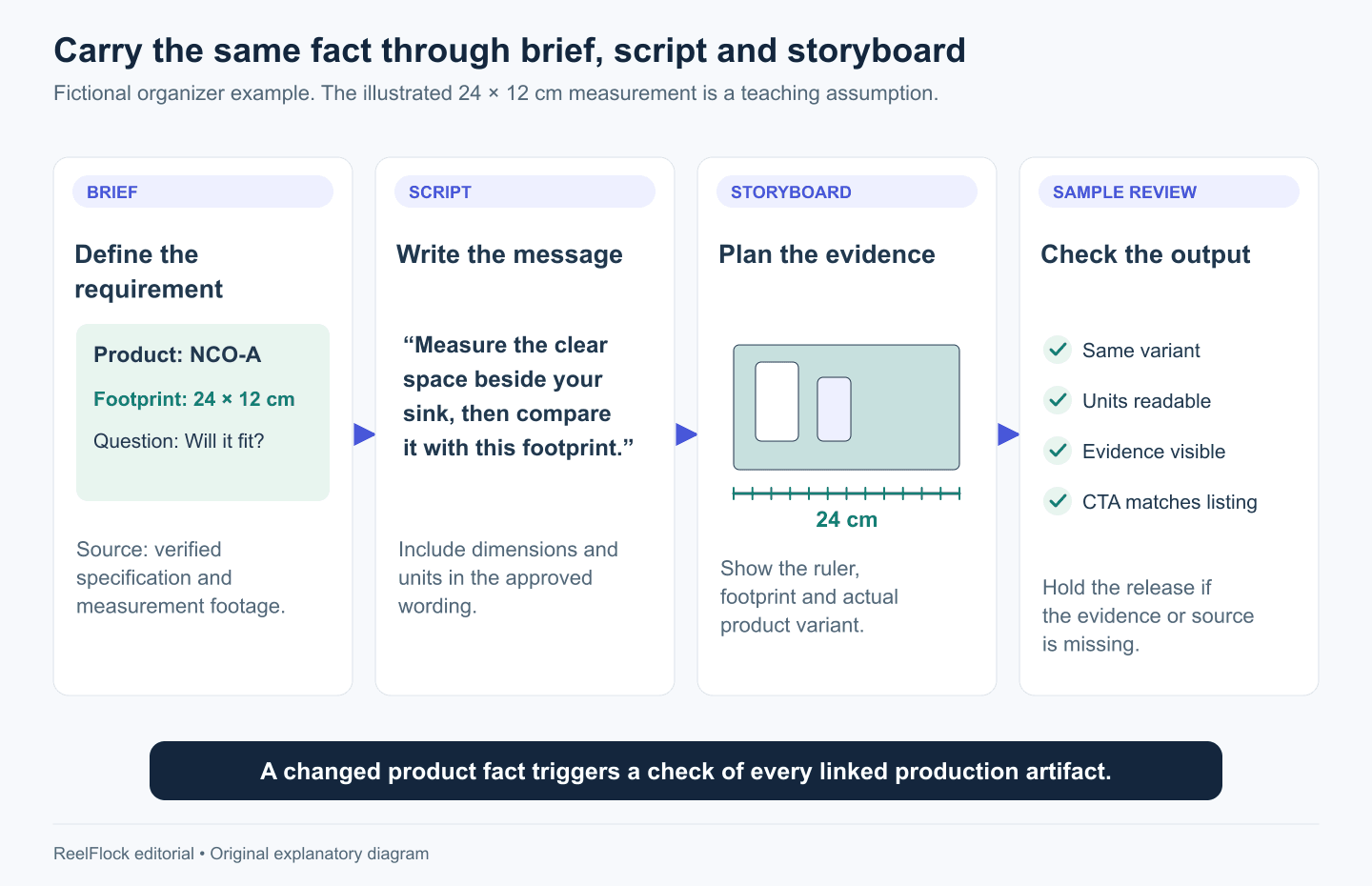
Carry the same product fact through the brief, script, storyboard and review. The organizer and 24 × 12 cm footprint are teaching assumptions.
Review a sample against the brief
Approve one representative sample per materially different concept before completing the variations. Ask whether it answers the named question, uses the correct product, preserves the evidence and ends with the agreed action.
Give feedback with a location, problem and requested outcome: “At 00:06, the width label says 14 cm; use the approved 12 cm figure and confirm the measurement footage matches.” This is actionable and easy to verify.
Consolidate feedback through the named approver. If a stakeholder introduces a new audience, product or claim after sample approval, record it as a scope change. That keeps revisions from quietly becoming a different campaign.
Use the approved brief to start production in ReelFlock
The completed brief provides ReelFlock with useful starting material: a product source, verified selling points, audience, script direction and required outputs. Use those inputs to develop scripts and product-video variations, then assign the appropriate accounts for production.
Keep the brief open during review. ReelFlock can help produce the batch; your acceptance checks decide whether the product, promise and CTA survived the process. The workflow does not require assuming that every field in this template has a direct import control.
Start with the ReelFlock script workflow using the product facts and one main message from your completed brief.