
TikTok Shop lets people discover products in TikTok and complete purchases within the platform. For a seller, the basic flow is to register a shop, create eligible product listings, connect the relevant TikTok accounts, publish product content, and fulfill the resulting orders.
The important operating detail is that a shop, a TikTok account and a product video each do a different job. The shop manages the merchandise and orders. The account presents the products. The video gives a shopper a reason to investigate a specific listing.
What is a TikTok Shop?
A TikTok Shop is a seller's ecommerce operation inside TikTok. It contains product listings and provides seller tools for managing the commercial side of those sales. Viewers can discover merchandise through short videos, LIVE and profile shopping surfaces. TikTok: Shop and Showcase.
Showcase is the shopping display associated with a TikTok account. It can contain products from a seller's own shop or products an eligible creator promotes. Seeing a shopping display on a profile therefore does not tell you that the account owns all the products shown there.
An independent-store product link serves a different purchase path: the shopper visits an external store to complete the transaction. When planning content, establish which path you are using so the spoken CTA and the actual destination agree.
Follow one purchase from discovery to fulfillment
Consider a fictional seller offering a countertop organizer. A shopper sees a video showing a crowded counter, watches the organizer being loaded, and opens the tagged product. On the listing, they check dimensions, choose a color, review price and delivery information, then place an order.
The seller's work continues after checkout. Someone must maintain inventory, process the order through the applicable fulfillment arrangement, provide tracking where required, handle service questions and manage returns. Seller Center provides tools for products, orders, logistics and payments. TikTok Shop: Business FAQs, operational sections.
| Stage | Shopper's question | Seller's responsibility |
|---|---|---|
| Discovery | What problem does this solve? | Show a recognizable use case |
| Product inspection | Will it work for me? | Provide accurate dimensions, options and evidence |
| Checkout | What will I pay, and when can it arrive? | Maintain the offer and delivery information |
| Fulfillment | Has my order shipped correctly? | Follow the order's current fulfillment requirements |
| After purchase | How do I use it or resolve a problem? | Supply clear instructions and responsive support |
A video can improve the explanation at the beginning of this journey. It cannot compensate for an unavailable variant or an inaccurate delivery promise later in the journey.
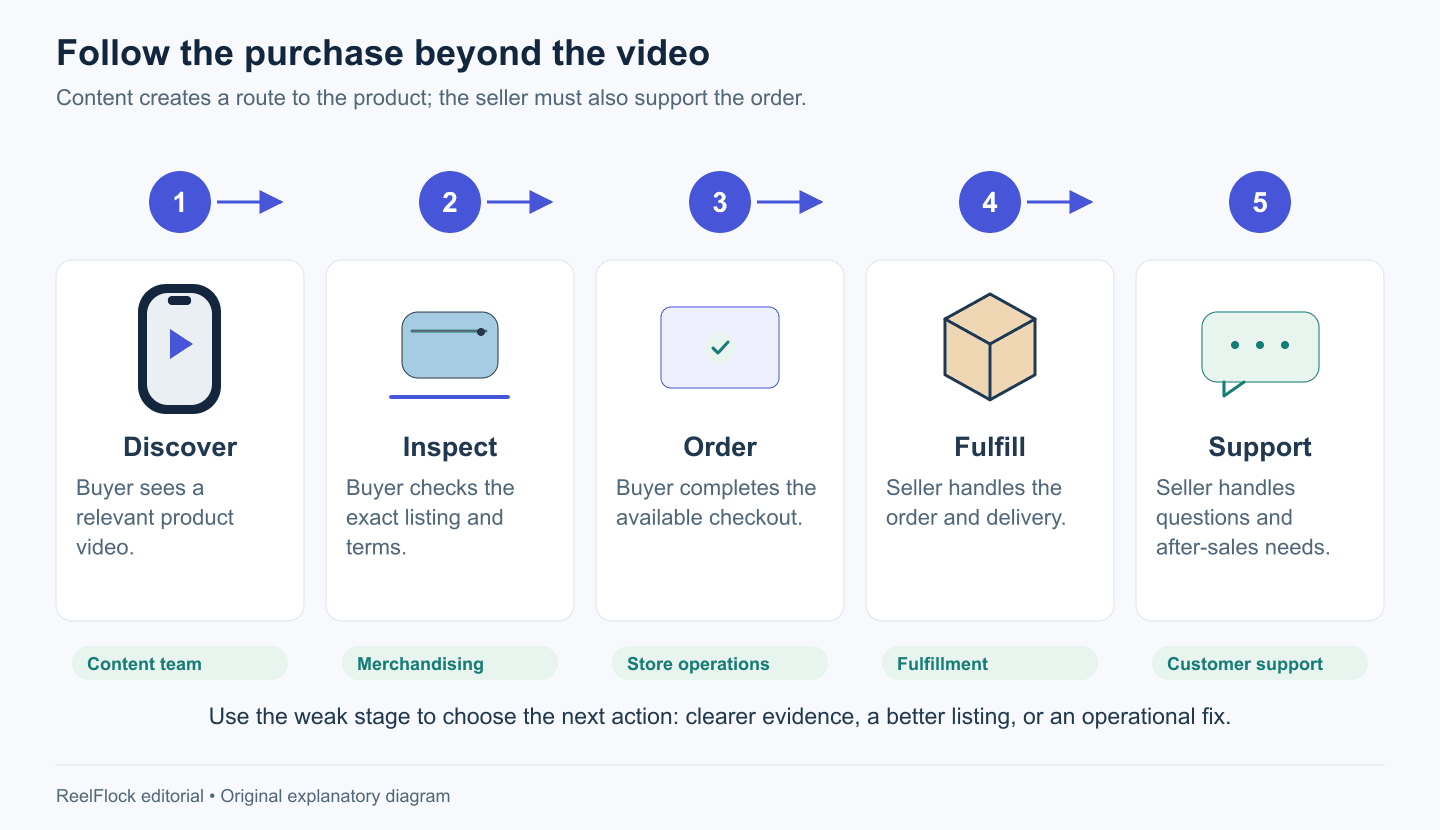
Follow the entire order path when diagnosing a weak result. Original seller workflow diagram; available checkout and fulfillment arrangements vary.
Understand the three main participants
Sellers own or manage the shop's product operation. They are responsible for merchandise information, inventory, offers and order handling under their arrangement with TikTok Shop.
Creators and affiliates help present products through their content. An affiliate relationship can involve a commission on attributed sales. Agree on the product, content expectations and commercial terms before sending samples or planning a campaign.
Buyers need enough information to make a confident selection. A creator's enthusiasm helps only when the product and listing support what the content says.
A seller can also operate its own content accounts. Current account binding and creator permissions determine what each account can promote. Follower requirements depend on the account's role and market, so consult the current eligibility policy when planning a launch. TikTok Shop US: Creator Eligibility Policy.
Set up the selling operation before increasing content volume
Use Seller Center for the current onboarding sequence in your market. Prepare the identity or business documentation requested for your seller type, payment details, warehouse and return information, and product records. Requirements can differ by entity and location; follow the fields and checks shown for your application.
Once the shop is approved, work through a launch checklist:
- Verify the first product. Check category eligibility, naming, images, specifications and any supporting documentation.
- Build its variants carefully. Match colors, sizes, pack quantities and stock to the correct identifiers.
- Confirm the fulfillment arrangement. Know who packs, labels and hands over orders, and which deadlines apply.
- Check the customer promise. Read the listing as a buyer would, including delivery, returns and care information.
- Connect the intended content account. Confirm its role and available shopping permissions.
- Preview the shopping path. Check that product content leads to the correct item and option.
Start with products your team can explain and fulfill reliably. A large catalog creates more opportunities for mismatched variants, outdated claims and unfinished content.
Work out whether the economics support the sale
Keep a contribution worksheet for each campaign. Include product cost, packaging, fulfillment, applicable platform charges, creator commission, seller-funded discounts, advertising and an allowance for expected returns or service costs. Current charges and settlement terms belong in Seller Center; introductory fee offers are a poor basis for a permanent margin model.
Here is a fictional planning calculation, using invented amounts solely to show the method:
| Item | Amount per order |
|---|---|
| Item revenue after seller-funded discount | $30 |
| Product cost | −$9 |
| Packaging and fulfillment | −$6 |
| Platform charges and creator commission | −$5 |
| Expected return/service allowance | −$2 |
| Contribution before advertising and overhead | $8 |
This example leaves $8 before advertising and overhead. If acquiring that order costs $10 in advertising, the illustrated order contributes −$2 before overhead. Replace every amount with your own verified assumptions; the example contains no TikTok fee quotation.
Keep commission and discounts tied to the offer version. Otherwise, a promotion can appear successful in a content report while producing a weaker commercial result.
Build content around the listing's hardest questions
For the fictional organizer, the useful questions are concrete: How wide is it? What fits inside? Does it need assembly? How does it look on a small counter?
Create a small content set that answers these questions in different ways:
- Demonstration: Load the organizer with familiar items so capacity is visible.
- Fit explanation: Show measured dimensions and the clearance a buyer needs.
- Setup tutorial: Show the real assembly or placement sequence.
- Comparison: Compare arrangements using the same items and conditions.
Each video needs a distinct reason to exist. Changing background music while repeating the same vague promise provides little additional information for a shopper.
Write the product, question, proof asset, featured variant and CTA in one row before making each video. This small record becomes especially useful when several accounts or creators are involved.
Diagnose the weak stage before making more videos
If the campaign disappoints, inspect where shoppers stop.
| Observation | What to inspect next |
|---|---|
| Viewers leave before the demonstration | Opening clarity, pacing and whether the product is visible |
| Comments repeat a question the video should answer | Missing evidence, confusing wording or unreadable detail |
| Product clicks occur but purchases are weak | Price, listing clarity, stock, delivery information and product fit |
| Purchases rise alongside returns | Expectation gaps, variant confusion, quality or instructions |
These observations suggest investigations. They do not prove a single cause. Review comparable windows and note changes to offers, stock and traffic sources before attributing a result to one script.
Turn the content plan into a repeatable ReelFlock workflow
Once the shop and listings are working, content production becomes recurring work. A new product needs an introduction, a demonstration and answers to objections; an existing product needs fresh explanations as customers ask different questions.
Bring those product facts and content angles into ReelFlock to develop scripts, assign available accounts for production and create batches of product videos. Review the exact variant, evidence and CTA in every output before approving publishing. Keep fulfillment and offer checks in your seller operations process.
Begin with the organizer's four questions, then expand the batch only after the first outputs explain them accurately. Create your first product-video batch with ReelFlock.